


- EN
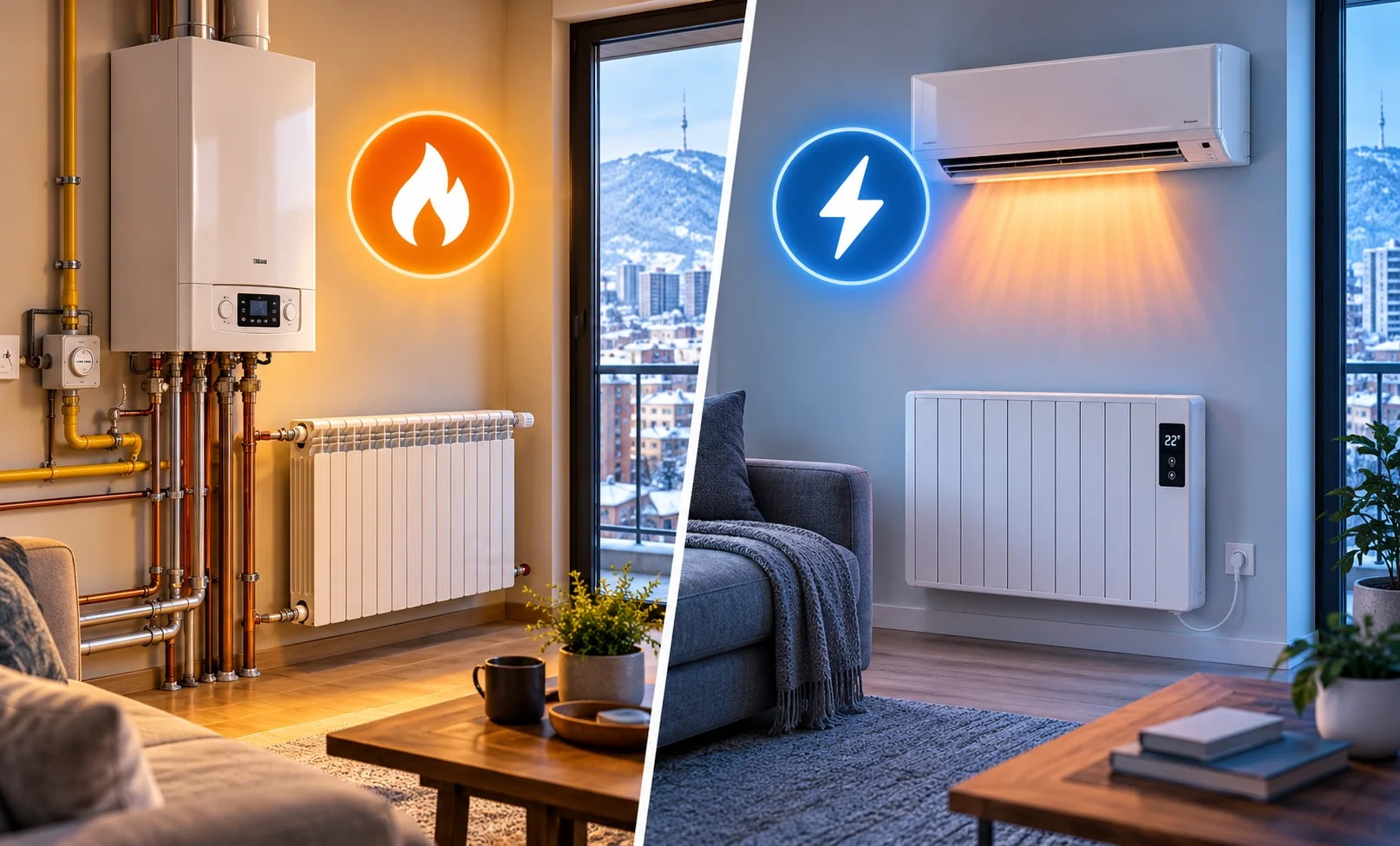

Heating cost in Georgia is one of the biggest parts of a family budget in winter. Before every winter, the same question comes up: what’s better — a gas boiler, an electric heater or an inverter air conditioner? In this article we compare which heating is the cheapest in Georgia using 2026 tariffs.
From 1 April 2026, the household electricity tariff in Tbilisi increased. Depending on consumption, it is approximately:
| Monthly consumption | Electricity (Tbilisi) |
|---|---|
| Up to 101 kWh | ≈ 20 tetri / kWh |
| 101–301 kWh | ≈ 24 tetri / kWh |
| Over 301 kWh | ≈ 28.5 tetri / kWh |
The household natural gas tariff in Tbilisi is about 54 tetri per 1 m³. Always check the exact current tariffs on the official website of the regulator GNERC.
For comparison we took an 80 m² apartment in Tbilisi with average insulation. During the heating season (November–March) such an apartment needs about 7,000–7,500 kWh of heat.
| Heating type | Price of 1 kWh of heat | Season cost | Average per month |
|---|---|---|---|
| Gas boiler + radiators | ≈ 6–7 tetri | 450–500 GEL | 90–100 GEL |
| Water underfloor heating (gas) | ≈ 6 tetri | 420–480 GEL | 85–95 GEL |
| Inverter air conditioner | ≈ 9–10 tetri | 600–700 GEL | 120–140 GEL |
| Electric convector / oil radiator | ≈ 28.5 tetri | 1,900–2,100 GEL | 380–420 GEL |
| Electric underfloor heating | ≈ 28.5 tetri | 1,900–2,100 GEL | 380–420 GEL |
Why is gas cheaper? 1 m³ of natural gas gives about 9.3 kWh of energy. A modern boiler turns 90% of it into heat, so 1 kWh of heat costs only 6–7 tetri. An electric heater turns 1 kWh of electricity into exactly 1 kWh of heat.
Why is an inverter 3 times cheaper than an electric heater? A heat pump (inverter air conditioner) “moves” 3–4 kWh of heat from the outside air using 1 kWh of electricity. However, its efficiency drops in severe frost.
| System (80 m²) | Approximate installation cost |
|---|---|
| Gas boiler + 5–6 radiators | 4,000–8,000 GEL |
| Water underfloor heating | 6,000–10,000 GEL |
| 3 inverter air conditioners | 3,000–5,000 GEL |
| Electric convectors | 800–2,000 GEL |
Electric convectors are the cheapest to install but the most expensive to run. Within 2–3 winters, a gas boiler pays back the difference in installation cost. For an exact amount, use the heating calculator.
Numbers in a table are useful, but when the heating cost of each system sits on one chart, the difference becomes much clearer. Below is the cost of one season (November to March) for an 80 m² apartment in Tbilisi with average insulation, at 2026 tariffs.
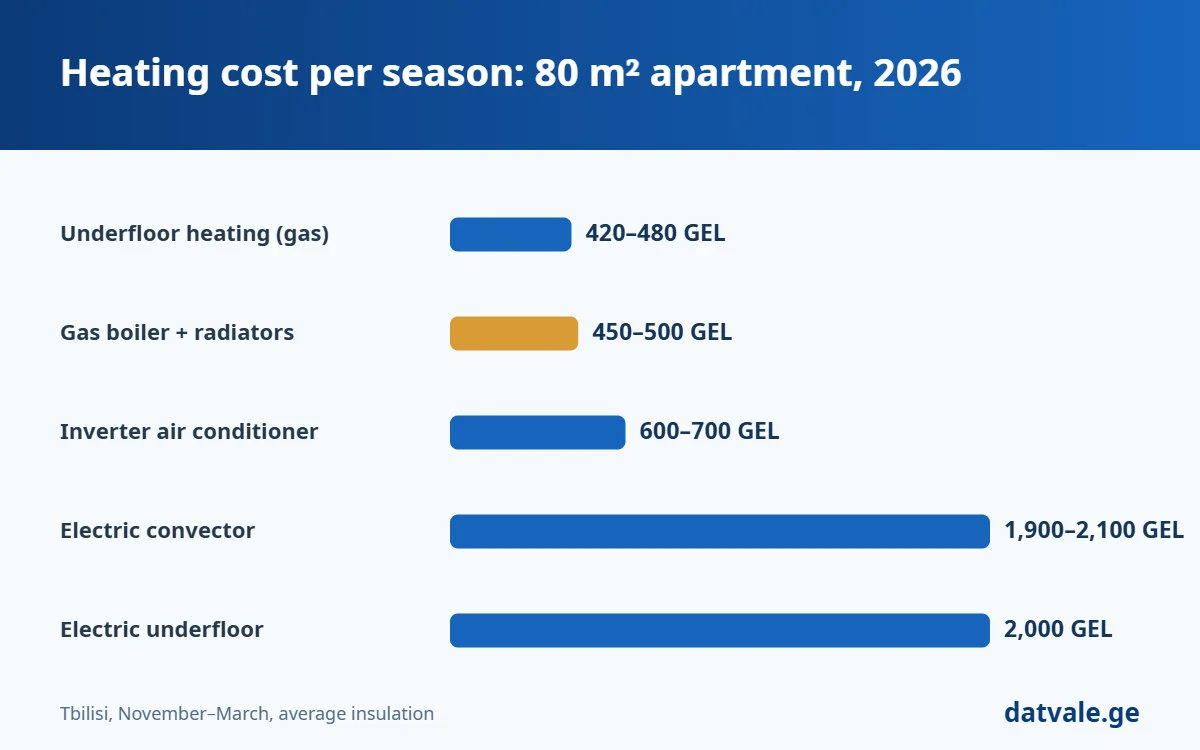
As you can see, the heating cost with electric convectors is about four times higher than with a gas boiler. That difference is up to 1,500 GEL in one season and over 7,000 GEL in five years, almost as much as installing a complete gas system.
Many readers want to know what the heating cost will be in a smaller or larger apartment. Here are indicative figures for three typical sizes under the same conditions: average insulation, a middle floor and a room temperature of about 21–22°C.
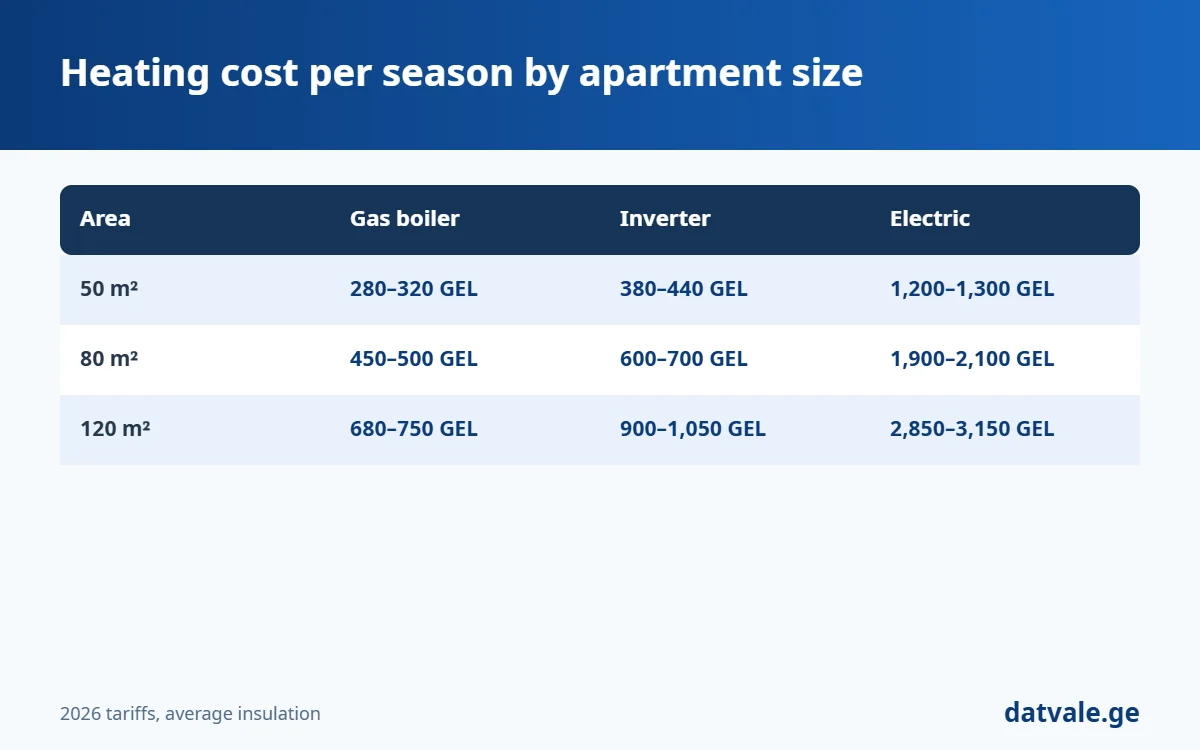
Keep in mind these are averages. On the top or ground floor, in a corner apartment or with poor windows, the heating cost can be 20–40% higher. In a well-insulated new building, it can be 15–25% lower.
When choosing a heating system, people often compare only installation prices. That is a mistake: a system runs for 10–15 years, and the main expense is yearly consumption. Let’s calculate the total cost for an 80 m² apartment using average figures:
| System | Installation | 5-year total | 10-year total |
|---|---|---|---|
| Gas boiler + radiators | ≈ 6,000 GEL | ≈ 8,400 GEL | ≈ 10,750 GEL |
| 3 inverter air conditioners | ≈ 4,000 GEL | ≈ 7,250 GEL | ≈ 10,500 GEL |
| Electric convectors | ≈ 1,400 GEL | ≈ 11,400 GEL | ≈ 21,400 GEL |
An interesting result: in total, an inverter air conditioner comes out at almost the same price as a gas boiler, especially in the first years, and it also cools in summer. However, a gas system gives more comfortable, even heat, also makes hot water and works reliably in hard frost. Electric convectors are clearly the most expensive option in the long run.
Wall, ceiling and floor insulation has the biggest impact. In an old building without insulation, an apartment of the same size can need twice as much heat as in a modern, well-insulated building.
Old wooden or single-glazed windows lose 20–30% of the heat. Modern double glazing and a good seal reduce the heating cost considerably.
On the top floor, heat escapes through the ceiling; on the ground floor, through the floor. A corner apartment has two or three external walls, and north-facing rooms get almost no sun. All of these raise the heating cost.
An apartment with 3.2 m ceilings needs about 15–20% more heat than one with 2.7 m ceilings, because there is more air to heat.
As a rule of thumb, every extra degree of room temperature increases the heating cost by about 5–6%. Choosing 21°C instead of 24°C can save up to 15% per season.
A boiler that has not been serviced for years, dirty radiators or air in the system reduce efficiency by 10–15%. Annual servicing usually costs 80–150 GEL and pays for itself in the first season.
General figures are a good guide, but you can calculate your own heating cost in a few minutes. You need three things: the floor area, the approximate heat demand and the price of energy.
For a 70 m² apartment, that comes to about 410 GEL with gas, 600 GEL with an inverter and 1,800 GEL with electric heaters per season. This simple formula lets you know your heating cost before choosing a system and compare it with the installation price.
If you choose gas heating, the next question is the boiler type. A standard boiler converts about 90% of gas energy into heat, while a condensing boiler reaches up to 105–108% (by lower heating value) because it also uses heat from exhaust vapor. In practice this means a 10–15% lower heating cost.
A condensing boiler costs 800–1,500 GEL more, so it pays off best in a large apartment, a private house or with water underfloor heating, where water temperatures are low and the boiler works at maximum efficiency. In a 60–80 m² apartment with radiators, a good standard boiler is also a perfectly sound choice.
An oversized boiler cycles on and off too often, which lowers efficiency and increases wear. As a guide, allow 1 kW per 10 m² with average insulation. For a combi boiler that also heats water, 24 kW is usually enough for an 80–100 m² apartment.
Many families combine two systems. The gas boiler runs in the coldest months (December, January and February), while in autumn and spring, when it is 8–15°C outside, an inverter air conditioner heats individual rooms quickly and efficiently. In summer, the same unit is used for cooling. This combination can cut the seasonal heating cost by 10–20%, because you no longer need to run the whole system to heat one room in mild weather.
In Tbilisi’s climate, where most winter days are between 0 and 8°C, a good inverter works quite efficiently and its heating cost is only 30–40% higher than a gas boiler. In mountain regions with frequent hard frost, gas or solid fuel is the better choice.
In a private house, the heating cost is usually higher than in an apartment of the same size, because a house has external walls, a roof and a floor on every side and no neighbors’ heat to help. A 120 m² house with average insulation uses 900–1,300 GEL of gas per season, and a poorly insulated one 1,500 GEL or more. In a house, insulation has a much bigger effect: insulating the roof and walls can cut the heating cost by 30–50%.
Take an 85 m² apartment in Vake, on the fifth floor of a 1980s building. The family used a gas boiler and paid 150–170 GEL a month for gas in winter. In autumn they took three simple steps: replaced old windows with modern double glazing, had the boiler serviced and installed a programmable thermostat.
The following winter the monthly bill fell to 105–120 GEL, about 30% less. The thermostat and servicing cost under 300 GEL and paid for themselves in the first season. The windows were more expensive, but comfort improved a lot: the drafts and the cold near the windows disappeared.
Partly true, but only if someone is always home. If the family is at work during the day, lowering the temperature by 3–4°C with a thermostat is more economical than heating an empty apartment. The key is not to switch the boiler off completely and let the apartment get cold, because reheating the walls takes a lot of energy.
Oil radiators, convectors and any other electric heaters turn 1 kWh of electricity into exactly 1 kWh of heat. The difference is only in how heat is distributed, not in efficiency, so their heating cost is about the same and the highest of all systems.
A window left open for a long time does raise the heating cost, but a full 5–10 minute airing twice a day is essential to prevent damp and mold. Dry air heats up faster, so short, proper ventilation barely affects the bill.
A new building does not always mean good insulation. Many façades are uninsulated and the windows are often the developer’s cheapest choice. Before buying, ask what insulation the walls have and what windows are installed.
Old and cheap models do struggle in frost, but modern inverter air conditioners, especially winter-rated series, heat efficiently down to −15°C. That is more than enough for Tbilisi’s climate.
If you are renovating now, this is the best time to reduce your future heating cost. After the renovation, many changes become far more expensive because they mean damaging walls and floors. Plan radiator positions under windows and insulated pipes, decide on underfloor heating before the screed, consider thin internal insulation on external walls in corner or top-floor apartments, replace windows before finishing the reveals, and size the wiring correctly if you plan to heat with inverters. You can estimate the cost of a heating system in Datvale‘s renovation calculator.
In 2026, the gas boiler still has the lowest monthly heating cost in Georgia: about 450–500 GEL per season for an 80 m² apartment. An inverter air conditioner costs 30–40% more to run but less to install and also cools in summer, so over 10 years its total cost is almost equal to gas. Electric convectors are only suitable as backup heating. Whatever you choose, the biggest savings come from insulation, good windows, a thermostat and regular servicing, steps that often cut the heating cost by 20–30% while making your home more comfortable.
Enter the number of radiators and boiler class — get an approximate installation cost.
With average insulation, about 450–500 GEL per season, or 90–100 GEL per month.
An inverter air conditioner is about 3 times cheaper than an electric heater, but 30–50% more expensive than a gas boiler.
Yes, from 1 April 2026 the household tariff increased and in Tbilisi it is ≈ 20–28.5 tetri per kWh, depending on consumption.
Electric convectors, although their monthly cost is the highest. In the long run, a gas boiler is the most cost-effective.
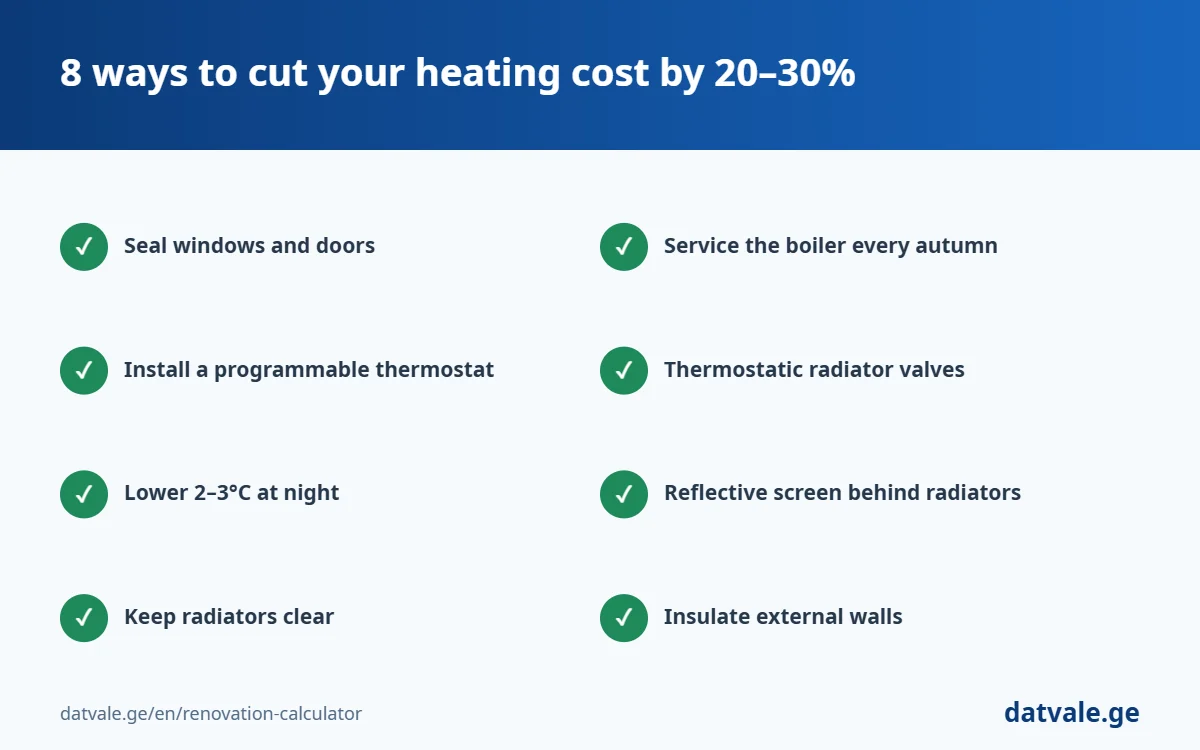
A programmable thermostat that lowers the temperature at night and when nobody is home usually saves 10–15%.
For an 80 m² apartment the total is almost equal, about 10,500–10,750 GEL. Gas gives more comfortable heat and hot water, while an inverter also cools in summer.
As a guide, 1 kW per 10 m² with average insulation. For an 80 m² apartment, a 24 kW combi boiler including hot water is usually enough.