


- EN
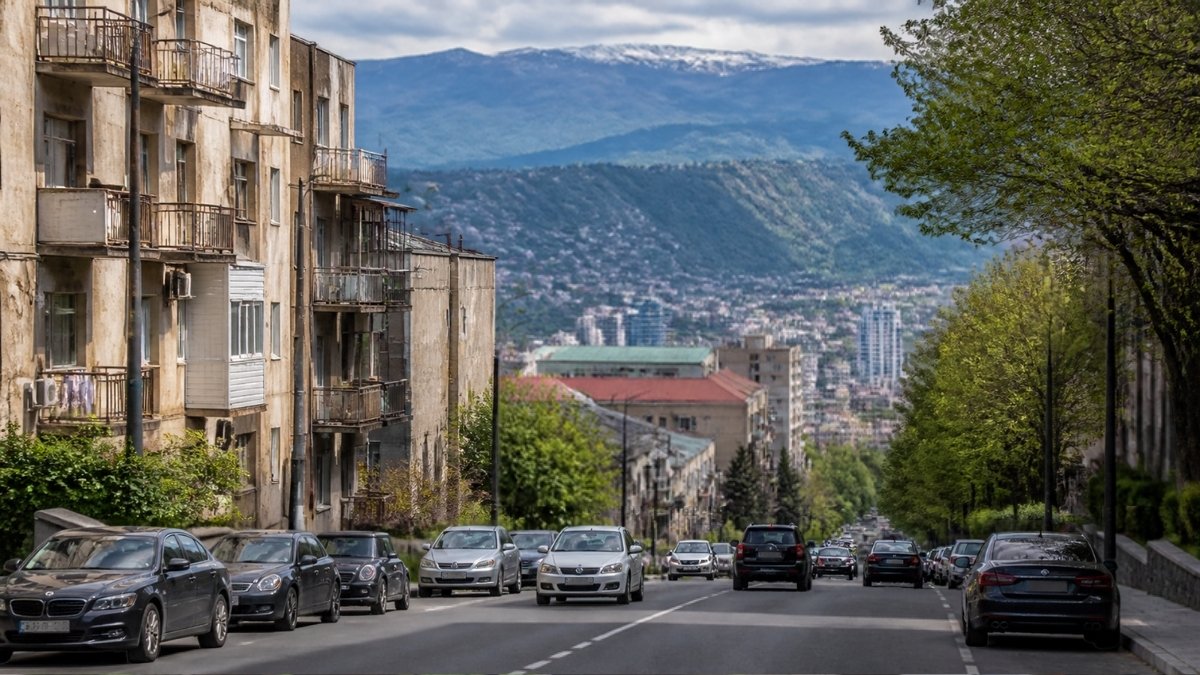

Tbilisi neighborhoods by traffic is one of the first things to check when choosing an apartment. A beautiful flat at a good price can become a daily struggle if the trip to work or to your child’s school stretches for hours at peak times.
If you are wondering how Tbilisi neighborhoods compare by traffic, this article will simplify your choice. We will not give invented minute counts or ratings. Instead, we will show you how to assess commuting comfort along your own routes, what known characteristics the main districts have, and which questions to answer before buying.
Many buyers compare apartments by area, renovation and price, and only later realize how much the commute matters. In reality, it determines how pleasant living there will be for years.
A good practice is to write a one-page list before choosing: where you go five times a week, where you go twice, and where you go rarely. This list should form the basis of your neighborhood assessment.
The purchase price is a one-time cost, while travel time is daily. If you spend extra time in transport twice a day, over a year that adds up to dozens of hours.
So assessing Tbilisi neighborhoods by traffic is as important as the price. A cheap flat in a distant area often ends up costing more later: more fuel, more taxis, less free time.
When you compare Tbilisi neighborhoods by traffic, you will see that a price difference is often partly offset by the time spent on the road.
Commuting costs three things: time, money and energy. Someone stuck in traffic returns home more tired, which affects family life too.
The same neighborhood can be ideal for one person and poor for another. If you work within the district or remotely, traffic matters less to you. If you travel to the far side of the city every day, it becomes the main factor.
The city’s transport situation changes constantly: new roads, changes to traffic rules and the renewal of public transport all redistribute demand. So do not rely on old impressions; always check the current situation.
In recent years the number of cars in the city has grown, and new residential complexes often appeared without widening existing roads. As a result, some main roads have been congested for a long time.
This does not mean all neighborhoods are equally heavy. The difference is large between areas served by a metro line and those that depend on a single road.
Tbilisi is stretched along the Mtkvari river, so most traffic is funneled onto a few main roads. New neighborhoods were built quickly, while the road network did not grow at the same pace.
The river can be crossed only at limited points, so demand naturally rises at bridges and the junctions next to them.
Parts of the city are built on hills and narrow streets, where widening roads is difficult. In older neighborhoods, street parking also adds to congestion.
Peak times also shift by month. Load is higher during the academic year, while in summer some directions become lighter. So do not judge a flat based on observations from a single season.
Ideally, check a neighborhood in two different months. If that is not possible, ask locals how conditions change when the school year begins.
Traffic gets heavier in the morning and evening, when people commute to work. At the start of the school year this is especially noticeable, as streets around schools and universities fill up.
The busiest roads are those that connect outlying districts to the centre. The inbound direction is often slowest in the morning.
In the evening, traffic spreads in the opposite direction and often lasts longer than the morning peak, because people leave work at different times.
On days off, routes to shopping centres and leisure areas are busy, as are the exits from the city toward the sea and the mountains.
In a test, what matters is not only the travel time but its consistency. A flat from which the trip takes twenty minutes one day and forty the next is harder to live with than a flat with a steady twenty-five-minute route.
Remember this difference: the average time is one number, but predictability is a different quality. People adapt more easily to a long but familiar route.
The most reliable method is not relying on ratings but running your own real test. The five steps below will give you the full picture within three days.
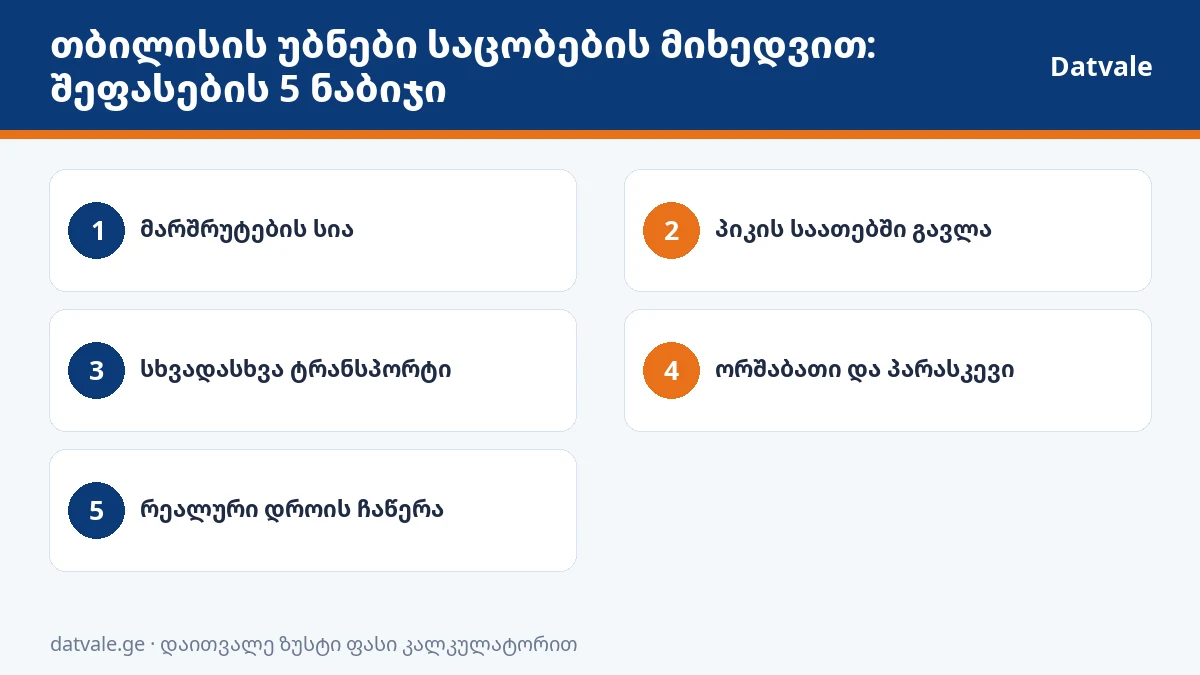
If you view the flat in the evening, plan to arrive during peak hours. Then you will see directly the street leading to the building and the exit route.
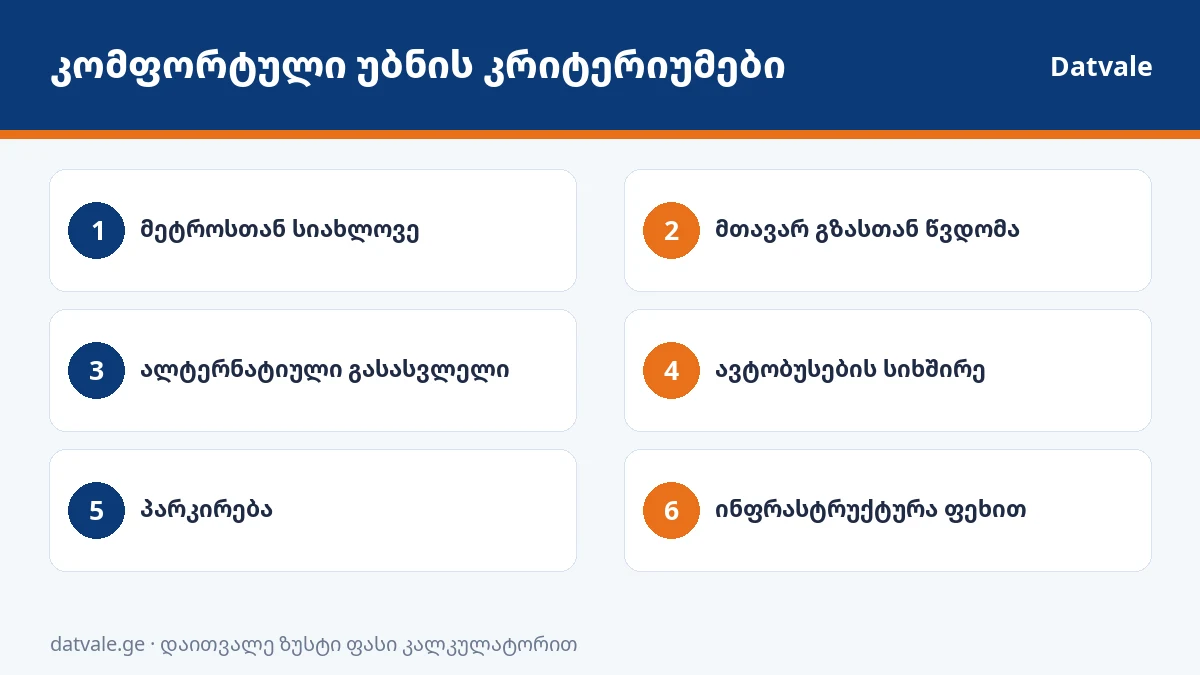
The criteria in the table depend on one another. For example, a good bus route often reduces parking problems, because car use is less necessary.
You can score each criterion from one to five and total the scores. This simple method reduces emotion and makes choosing between two flats easier.
One sign is not enough when assessing a neighborhood. Use the table below as a scoring framework for your specific options.
| Criterion | What to check | Why it matters |
|---|---|---|
| Proximity to metro | Walking time to the station | The metro is independent of road traffic |
| Access to main roads | How many junctions you pass | Many traffic lights mean more delay |
| Alternative routes | Is there a second exit | One blocked road slows the whole area |
| Public transport | Bus frequency | Ability to live without a car |
| Parking | Yard spaces, street parking | Parking often takes a large part of the day |
| Everyday infrastructure | School, shop, clinic within walking distance | Less need to travel |
If you depend on public transport, consider the last step as well: the way from the station or stop to your home. Often this stretch is the least convenient, especially on steep streets and in bad weather.
Also check how late transport runs in the evening. If you return late, a taxi alternative matters.
Tbilisi’s metro consists of two lines: the Akhmeteli–Varketili line and the Saburtalo line. Both connect at Station Square and serve a large part of the city centre.
Areas near metro lines are the most stable in terms of travel, because rail transport is not affected by road congestion. For example, Isani, Samgori, Varketili, Nadzaladevi, Didube and parts of Saburtalo belong to this group.
In districts without a direct metro station, travel depends on buses, minibuses and cars. In that case, the convenience of the bus route is especially important.
When choosing in Saburtalo, the specific quarter matters a great deal. Two parts of the same district can offer very different commuting comfort: streets near the metro give one picture, inner courtyards another.
Saburtalo is one of the most sought-after and populated districts. It has many shops, clinics, schools and offices, so handling everyday tasks on foot is easy.
Much of the district is on or near a metro line, and the infrastructure is varied. This means a personal car is not required every day.
The main avenues are congested at peak hours, and parking near supermarkets and universities is difficult. Before choosing, check which street the building is on and how close it is to the main junction.
In Vake it is especially worth finding out which street your route to the centre uses and how congested it is in the morning. The flat’s height or position on a slope can also make daily walking harder.
Vake is close to the centre, so many people reach work on foot or by a short trip. Its parks and green areas make it a prestigious place to live.
Proximity to the centre, parks and well-developed services. If your work is in the centre or Saburtalo, the trip may be short.
The area has no direct metro station; the nearest is usually next to the university. Main entrances load up at peak hours, and parking is limited on many streets.
In these areas, living comfort depends more on walking than on driving. If you like living this way, a central location saves a great deal of time.
Central neighborhoods are often expensive, but dependence on cars is low, because much is reachable on foot.
Work, cafés, theatres and administrative buildings are close. This means many residents simply avoid traffic altogether.
If you do own a car, parking can be a challenge, and narrow one-way streets make movement harder.
People living in the north often work in the centre or Saburtalo, so the commuting strategy should be planned in advance. The metro is a major advantage here.
The northern districts are large and relatively affordable. Many residents commute to the centre every day, so the direction is busy in the morning.
Both districts are on the first metro line, which greatly simplifies the connection to the centre. This makes them a good choice for people who want to live without a car.
Gldani is one of the largest residential districts in the city and has its own infrastructure: shops, schools and services are on site. Many residents therefore have work or study nearby.
Gldani is a large housing area without a direct metro station. Residents often use buses, minibuses or private cars, so travel time depends more heavily on the route.
Travel from the eastern districts to the centre by metro is clearly predictable in time. That is a decisive argument for many families, and a good starting point for young couples choosing a first home.
Eastern districts often attract buyers with affordable prices, and the metro line connects them directly to the centre.
Proximity to stations means you are less dependent on traffic in the morning peak. This is especially important for people who work in the centre every day.
If the flat is far from the station, the last stretch will depend on a bus or taxi. Calculate this time and cost.
When choosing housing on the outskirts, count all the costs: fuel, car wear, parking in the city. Often these extra costs partly offset the difference in purchase price.
The outskirts often offer more space and a pleasant environment, but travel depends more on a private car and on the main exits.
If you work remotely or your job is in the same direction, the outskirts can be very comfortable. Price and space are often better.
If you must reach the centre every day, a single congested main road slows the whole route. So when choosing the outskirts, be sure to test the peak hours.
Use the table as a starting point and then add your own route test. Even within the same district, different streets give different experiences.
The table is indicative and not an official ranking. It is based on well-known facts about the metro and infrastructure.
| District | Metro access | Main challenge |
|---|---|---|
| Saburtalo | Good, across much of the district | Peak-hour load, parking |
| Vake | Limited | Narrow entrances, parking |
| Vera, Mtatsminda | Partial | Narrow streets, parking |
| Didube, Nadzaladevi | Good, first line | Morning peak towards the centre |
| Gldani | No direct station | Dependence on buses and cars |
| Isani, Samgori, Varketili | Good, first line | Last stretch from the station |
| Digomi, Lilo | Limited | Dependence on a private car |
To check this criterion, draw the three main directions from your home on a map and see which one you use least often in traffic. If every route funnels through a single junction, the district’s mobility is limited.
Accidents, repairs or events that block a road happen often in the city. A district with only one exit is effectively trapped on such a day.
A neighborhood’s comfort often depends on whether residents have a choice. If one road closes, another saves time.
A dense network has several parallel streets, so traffic is spread out. A weak network means a single accident can stop the whole area.
When viewing a flat, check how many directions you can leave the district by and whether they all pass through the same junction.
If you buy in a new building, first find out how many spaces the underground parking has and whether they are included in the price. Sometimes more than one car comes with a flat, while the courtyard cannot accommodate them.
Think about visitors too: if parking in the area is difficult, friends will visit less often, or you will have to park far away.
Traffic is often created not on the road but by the search for parking. If there are no courtyard spaces, the daily time spent can double.
In new buildings, underground parking often adds to the price but saves time. In older districts, courtyard spaces are limited.
In central districts, street parking is paid or restricted, which should be factored into your budget.
Also keep in mind that changing a child’s school may become necessary in later years. A neighborhood with several schools and kindergartens offers more flexible options.
If you take your child to school every day, plan this route in both directions at peak times. The school itself is often a short distance away, but the morning can take a large part of the time.
For families, traffic means the school and kindergarten route. The morning peak coincides with this time, so proximity to school is often more important than proximity to work.
If the school is within walking distance, morning stress drops considerably. This is a major advantage when choosing a neighborhood.
Clubs, sports and clinics add extra routes. Factor them into your assessment.
A useful approach is to calculate the annual transport cost for each flat and divide it by the number of years you plan to live there. Compare the result with the difference in flat prices, and the picture becomes clearer.
When choosing a flat, we often look at the price alone, but commuting adds other costs: fuel, taxis, minibuses, lost time.
Tbilisi neighborhoods differ by cost as well as by traffic, so the price alone is not enough for comparison.
Write down your monthly transport cost for each option and add the monthly component of the flat if you are buying with a mortgage. Often a cheaper flat is not cheap at all.
To assess a flat’s market value objectively, use the calculator and compare different neighborhoods.
Sometimes a district is quiet today but changes soon: a shopping centre, a new block or an office complex opens. Such projects add traffic to nearby streets at certain times of day.
The city constantly undergoes road rehabilitation, new construction and transport changes. These alter a neighborhood’s congestion, temporarily or permanently.
If a large residential complex is being built in the area, traffic on nearby roads will likely increase. Ask neighbors and check construction plans.
Construction permits and urban planning documents are available from official sources. For population and demographic statistics, see the National Statistics Office of Georgia (Geostat) website.
Most mistakes come from one cause: deciding on the impression of a single visit. Several visits at different times greatly reduce this risk.
Buyers often repeat the same errors. They involve both commuting and price.
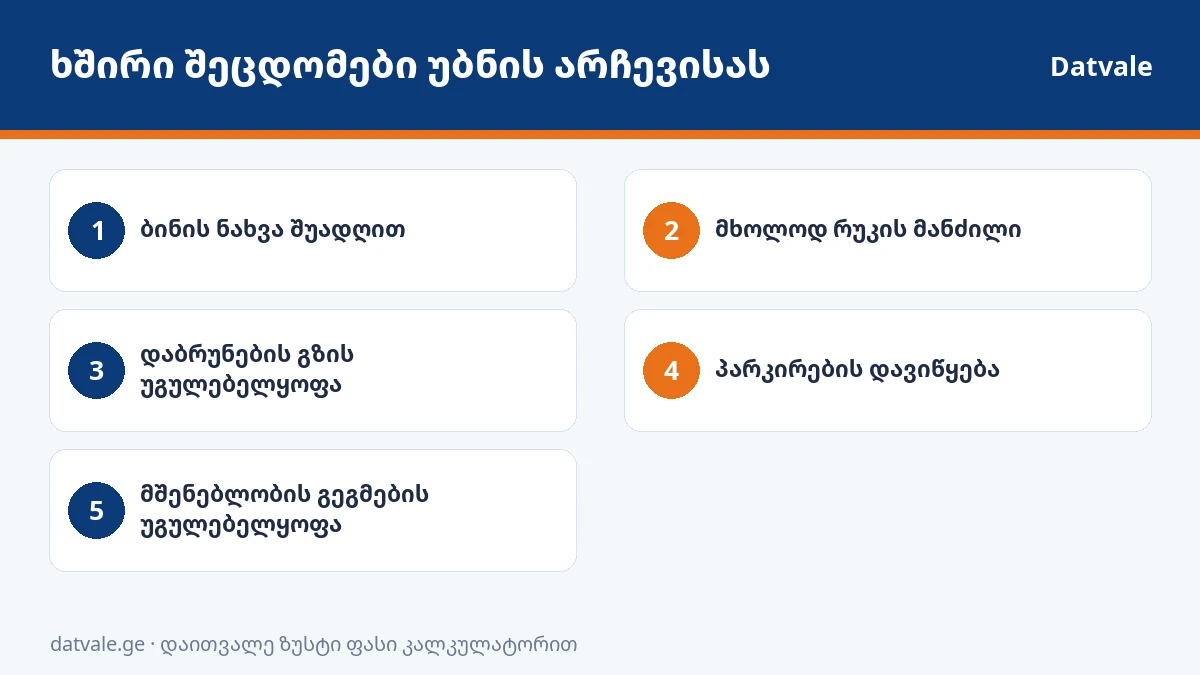
If two options are very close, decide based on which route spares your nerves more. Ten extra square metres do not compensate for daily stress.
And finally, remember that lifestyles change. Today a flat may suit you well, but after a child is born or you change jobs, the situation may be different.
Summarize all the assessments in one table and give each criterion a score. This turns an emotional decision into a rational one.
When you compare Tbilisi neighborhoods by traffic, three simple questions are enough for the final decision.
Ask yourself: Can I leave calmly in the morning? Can I pass the route back every evening? And is the price difference worth the time lost?
If your test shows that the route is significantly longer on your daily journey, the price advantage often will not compensate for it.
Enter the district, area and condition to get an estimated market valuation of the flat. Compare options across different neighborhoods.
In short, Tbilisi neighborhoods differ a lot in how easy daily travel is. Before choosing an apartment, visit the Tbilisi neighborhoods you like during peak hours and note how long each trip takes. This way you can compare Tbilisi neighborhoods not only by price, but also by the time you will spend on the road every day.
If you are choosing between several options, list the Tbilisi neighborhoods in one simple table: distance to the metro, main roads, school and work. This small step helps you compare Tbilisi neighborhoods objectively and choose with confidence. Many families who compared Tbilisi neighborhoods this way say the commute mattered more than they expected.
There is no single answer, because everything depends on your route. Districts near a metro line generally offer stable travel, while areas close to the centre have much within walking distance.
The most reliable way is your own test: drive your route from the flat to work at peak hours over several days and record the real time.
Yes, if your daily route goes toward the centre. The metro is independent of road traffic, though the walk to the station also needs to be convenient.
If you work remotely or your job is in the same direction, the outskirts may be a good choice. For daily commuting, however, they increase dependence on a car.
Often, yes. Commuting comfort, metro proximity and infrastructure influence demand and price, although a specific change cannot be predicted in advance.