


- EN
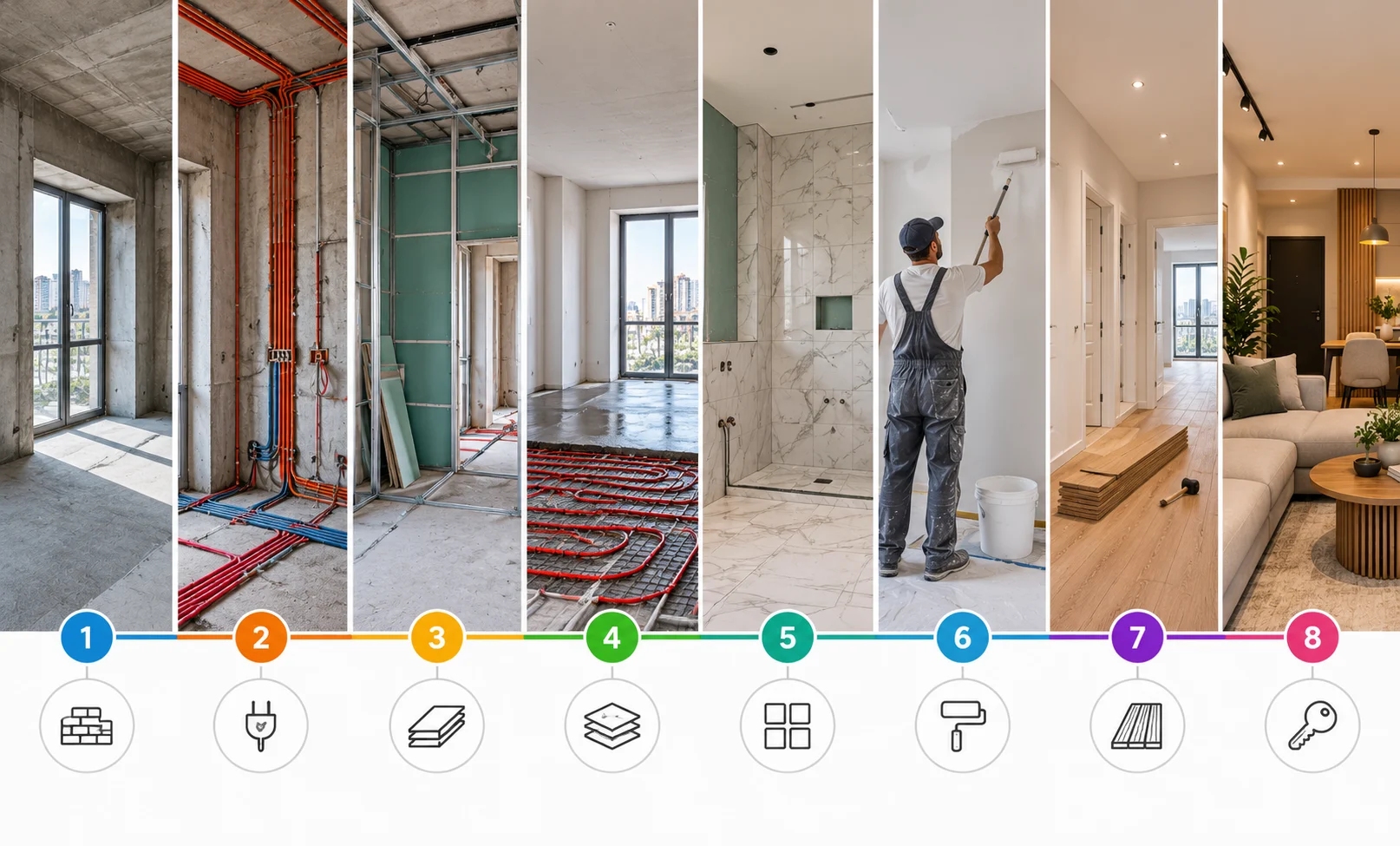
An apartment renovation timeline is one of the most poorly planned parts of any project. “We’ll finish in two months” often turns into four, while the owner keeps paying rent or double costs. Knowing the real timeline helps you plan your move, budget and contractor schedule correctly.
In this article we show, stage by stage and week by week, how long an apartment renovation takes in Georgia — from black frame to keys — and where the most time is lost.
| Apartment condition | 60–80 m² apartment | What determines the timeline |
|---|---|---|
| Black frame | 12–16 weeks | Partitions, plastering, screed drying |
| Green frame | 8–12 weeks | Heating, plumbing, finishing |
| White frame | 6–9 weeks | Putty, painting, flooring, bathroom |
| Cosmetic renovation | 2–4 weeks | Painting, replacing flooring, details |
Layout, positions of electrical points and plumbing, choice of materials. The more precisely you plan now, the fewer changes later — and changes are what stretch a renovation the most. Use the design calculator to estimate the cost of the project.
Block or drywall partitions, door openings and, if needed, demolition.
Cables, socket positions, water and sewage pipes. This is “hidden” work: redoing it later is very expensive and time-consuming.
After plastering, walls need time to dry. In winter, without heating, this process slows down noticeably.
This is the stage where time is lost most often. A cement screed must dry fully before flooring is laid. If you install laminate or parquet on a damp screed, it will warp. Other work can be done in parallel during this time.
Installation of the boiler, radiators or underfloor heating. Underfloor heating is installed before the screed.
Bathroom and kitchen tiles, wall putty and paint, stretch or drywall ceilings. This is the most “visible” and labor-intensive stage.
Laminate or parquet, interior doors, lights, sockets, sanitary fixtures and final cleaning.
When the renovation timeline is broken into stages, it is much easier to see where time is lost and which jobs can be sped up. Below is a typical schedule for a 60 m² apartment from black frame, week by week. The drying pauses are included, because they take up a large share of the time.
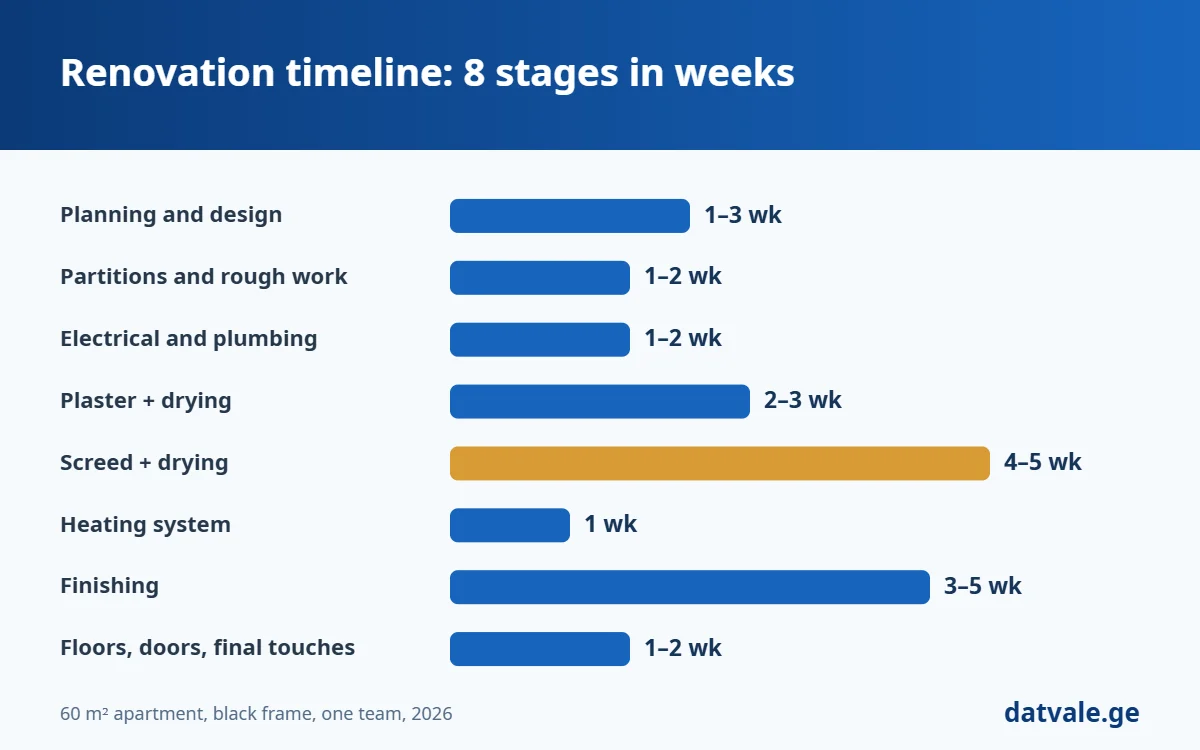
The longest stage is finishing, but the most “deceptive” one is the floor screed. The work itself takes a few days, but full drying needs 3–4 weeks. If you use that time well, for example by plastering walls or working on ceilings, the overall renovation timeline shrinks considerably.
Your renovation timeline depends first of all on the condition in which you receive the apartment. The more work there is, the more technological pauses are needed. The figures below apply to a 60 m² apartment, one team and standard-class materials.
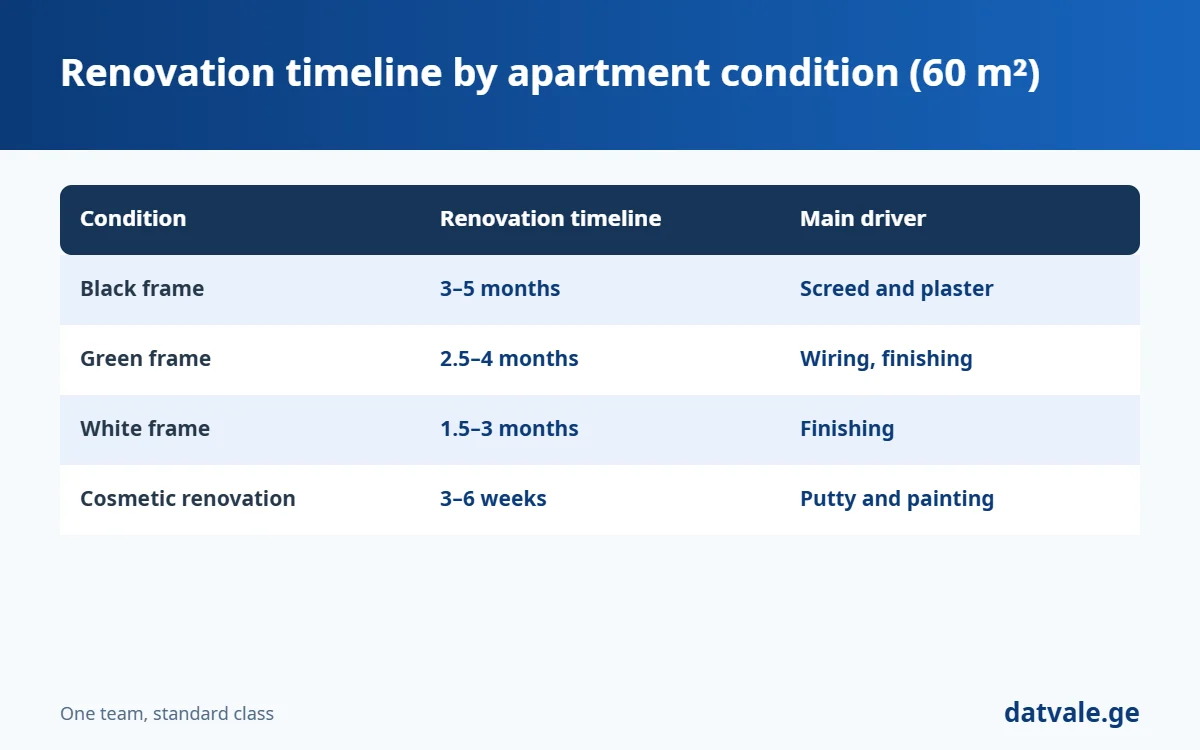
These timelines assume materials are ordered on time and trades hand over to each other smoothly. In practice, a renovation timeline often grows by 20–30% because of organizational reasons rather than the difficulty of the work itself.
The most dangerous way to shorten a renovation timeline is to cut drying time. Materials have physical limits, and if you ignore them you get cracks, swollen laminate or falling tiles. Here are indicative drying times for the main materials:
| Material / job | Indicative drying time |
|---|---|
| Cement screed (5 cm) | 3–4 weeks |
| Self-leveling compound | 3–7 days |
| Gypsum plaster | 7–10 days |
| A coat of putty | 12–24 hours |
| Tile adhesive | 24–48 hours before grouting |
| Waterproofing | 24–48 hours |
| Water-based paint | 2–4 hours between coats |
Note that these times vary with temperature and humidity. In winter, in an unheated apartment or in high humidity, drying can take twice as long. That is why a winter renovation timeline should always be planned more carefully.
The simplest old trick: lay a 1×1 m piece of plastic film on the screed and tape down the edges. If condensation or a damp patch appears under the film after 24 hours, the screed is still wet and it is too early to lay laminate or parquet. Professionals use a moisture meter for this.
Many people think the renovation timeline depends only on how fast the contractors work. In reality, work very often stops because a material or item has not arrived yet. Some items have lead times of several weeks:
So order these items at the start of the renovation, not when the contractor tells you “we need the doors tomorrow”. Some can only be measured at a specific stage, for instance the final size of a door opening is known only after plastering, so put the measuring date into your schedule in advance.
A realistic schedule is just as important as the renovation budget. A well-made renovation timeline helps you order materials on time, call trades in the right order and know when you can move in.
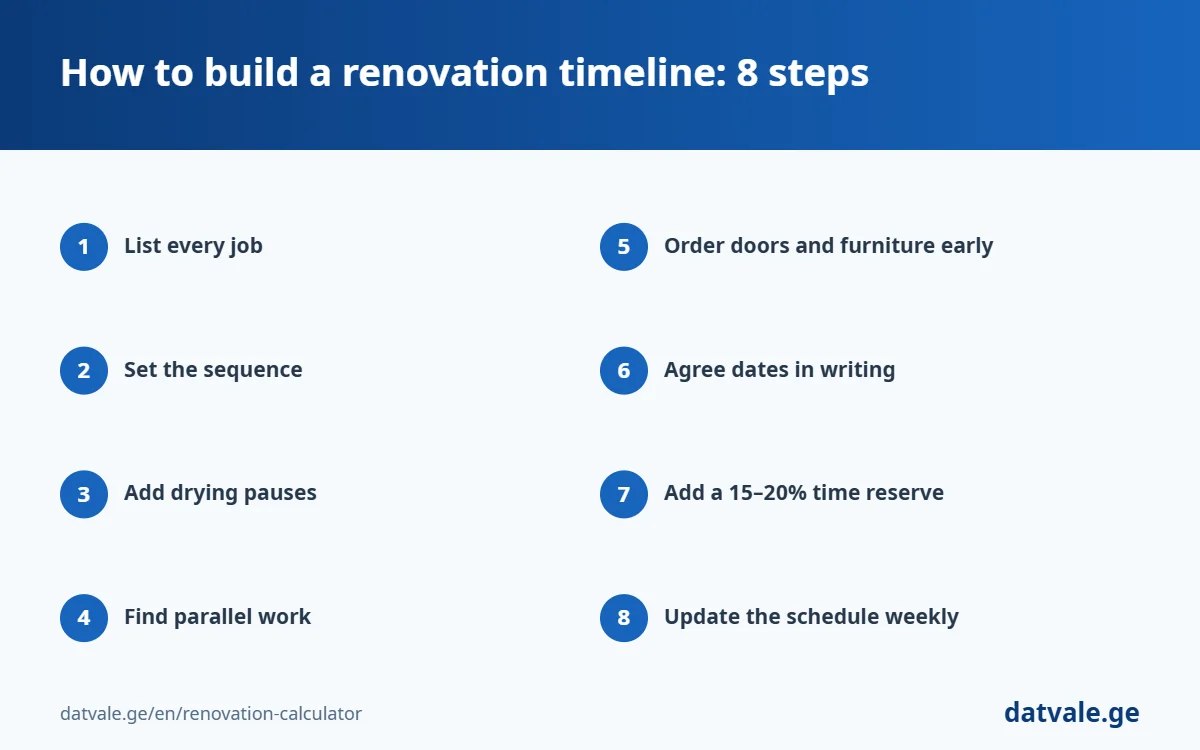
The most effective way to shorten a renovation timeline is to distribute the work correctly. While the screed dries in one room, plastering can go on in another. While putty dries on the walls, tiles can be laid in the bathroom.
One condition: parallel work requires good coordination. Dusty work such as sanding putty must not coincide with painting in the same space. So someone, whether you, a foreman or a supervisor, must be responsible for the whole renovation timeline.
If you are not doing a full renovation and only need to update one or two rooms, room-by-room timelines are more useful than an overall schedule. Here are indicative times for individual spaces when the hidden work is already done:
If you live in the apartment and renovate in stages, start with the bathroom or kitchen: these are the most complex and noisiest jobs. You can then update the living rooms one by one without having to move out.
Weather directly affects your renovation timeline. In summer, plaster and screed dry faster, but on very hot days the surface dries too quickly and can crack, so it needs to be dampened. In winter, if the apartment has no heating yet, drying slows down 1.5–2 times, and some mixes cannot be used below +5°C at all.
The ideal time to start “wet” work is spring and early autumn. If you start in winter, install the heating system or temporary heaters first. This will cut the renovation timeline by several weeks and protect quality.
When planning, take into account the New Year and Easter periods, as well as August, when many contractors and stores are on vacation or working reduced hours. These one or two weeks often become the biggest “invisible” loss in a renovation timeline.
Take a real case: a 60 m² two-bedroom apartment in Didube, from black frame, standard class. The renovation started in early March. Planning and design took 2 weeks, then partitions and electrical and plumbing installation took 3 weeks. Plastering and screed started in week 6; while the screed dried, the team worked on ceilings and bathroom waterproofing.
Finishing (tiles, putty and painting) took 5 weeks, and flooring, doors and final touches took 2 weeks. The kitchen furniture was ordered early, in week 4, so it arrived exactly on time. The result was a renovation timeline of 16 weeks, about 4 months, which is a good result for black frame. The family said that ordering early and parallel work saved them the most time.
In an old apartment, the renovation timeline is often longer than expected, because demolition alone takes 1–2 weeks: removing old tiles, plaster, flooring and wooden frames, plus waste removal. Then come the “surprises”: damaged pipes, old wiring and uneven walls that need extra plastering.
That is why it is recommended to plan an old-apartment renovation timeline with a 20–30% reserve. A full renovation of a 60 m² apartment in an old building usually takes 3–4.5 months, even if the area and scope are similar to a new build.
A verbal “we’ll finish in two months” is no guarantee. In the contract, or at least in a written agreement, include:
Such terms do not scare a contractor away; they create clear rules for both sides. Good contractors usually agree to a realistic renovation timeline when it is drawn up together.
Many owners see the renovation timeline as a matter of patience, but every extra month is a direct cost. If you rent while renovating, a two-month delay can cost 1,200–2,000 GEL. If you plan to rent the apartment out, every month is lost income. If the renovation is financed by a loan, interest is paid every month whether or not the work is finished.
So it is sometimes more profitable to pay a little more for an organized team or supervision if it shortens the renovation timeline by several weeks. Do the math: one month of rent or lost income often exceeds the difference between cheap and mid-priced contractors.
The main mistake is when every contractor works for themselves and nobody knows who should come when. The electrician waits for the plasterer, the plasterer waits for the plumber, and the plumber is at another site. A week disappears very quickly that way.
The right approach is to shorten the renovation timeline through organization (early orders, parallel work and good coordination), not by breaking the technology.
A realistic renovation timeline for a 60 m² apartment is 3–5 months from black frame, 1.5–3 months from white frame and 3–6 weeks for a cosmetic renovation. To shorten it, order long-lead items at the start, use drying pauses for parallel work, put dates in the contract and add a 15–20% time reserve. Do not rush drying: a week “saved” that way turns into months of cracks and rework later.
Official information on building regulations and permits in Georgia is available on Matsne.
Calculate renovation costs with materials and labor so work never stops at any stage.
On average 3–4 months, if materials are bought on time and the project doesn’t change during the work.
Finishing and screed drying. A screed needs 3–4 weeks before flooring can be laid.
Yes, but plaster and screed need heating to dry, otherwise the renovation timeline gets longer.
Ask for weekly photo and video reports and tie payments to completed stages.
With good coordination, usually by 2–3 weeks in a 60 m² apartment, especially while the screed and plaster are drying.
At the very start of the renovation. Lead times are often 3–8 weeks, so a late order directly extends the renovation timeline.
After the final painting and cleaning, it is best to air the apartment well for 3–7 days, especially if children or people with allergies will live there.