


- EN


Contractor price increase is one of the most common renovation surprises: the price agreed at the start is often very different from the final bill. If you’ve ever heard “some extra work came up”, you know what we mean. A growing budget isn’t always fraud, but it is often the result of a vague agreement that lets the contractor raise the price.
In this article we cover the 7 most common tricks that inflate renovation costs — and simple ways to protect yourself.
The contractor quotes a tiling price per m², but later charges separately for leveling walls, primer, waterproofing and cutting tiles. In the end the price can grow by 30–50%.
How to protect yourself: ask in advance what is and isn’t included. Request a list: preparation, main work, finishing.
A normal reserve is 10% for tiles and 5–7% for laminate. Some contractors ask for 20–25%, and the surplus later “disappears” to another site.
How to protect yourself: calculate quantities yourself with a calculator and compare them with the contractor’s list.
The contractor recommends a specific store or brand. Sometimes that comes from experience — sometimes from a commission paid by the store.
How to protect yourself: compare prices in 2–3 stores and use Datvale partner discounts.
“150 GEL per day” sounds transparent, but the timeline is in the contractor’s hands. Two weeks of work can easily stretch to a month.
How to protect yourself: tie the contractor price to the scope of work, not to time. A daily rate is acceptable only for small jobs that can’t be defined in advance.
After opening a wall, the contractor says the pipes or wiring must be replaced. Sometimes this is true — sometimes it isn’t.
How to protect yourself: ask for a photo or video of the problem and, if needed, a second specialist’s opinion. Approve extra work only in writing.
“I need 70% upfront to buy materials” is one of the riskiest situations. Once paid, the contractor has less motivation to finish on time.
How to protect yourself: pay in stages based on completed work. It’s better to buy materials yourself.
Halfway through the renovation, the contractor says prices went up and labor must cost more too. If the contract doesn’t say so, it’s only their decision.
How to protect yourself: state in the contract that the labor price is fixed for the entire project.
Knowing market prices is the best protection. Here are approximate labor prices for 2026 in Georgia:
| Work | Approximate price |
|---|---|
| Tile installation | 35–65 GEL / m² |
| Laminate installation | 8–18 GEL / m² |
| Parquet installation | 15–50 GEL / m² |
| Stretch ceiling (with installation) | 27–45 GEL / m² |
| Plumbing point | 55–180 GEL / piece |
For detailed prices, see Renovation labor costs 2026.
The table above covers the main jobs, but a renovation has many more line items. The more prices you know in advance, the harder it is for anyone to sneak in a contractor price increase. Below are indicative labor prices in Tbilisi for the most common jobs, labor only, without materials.
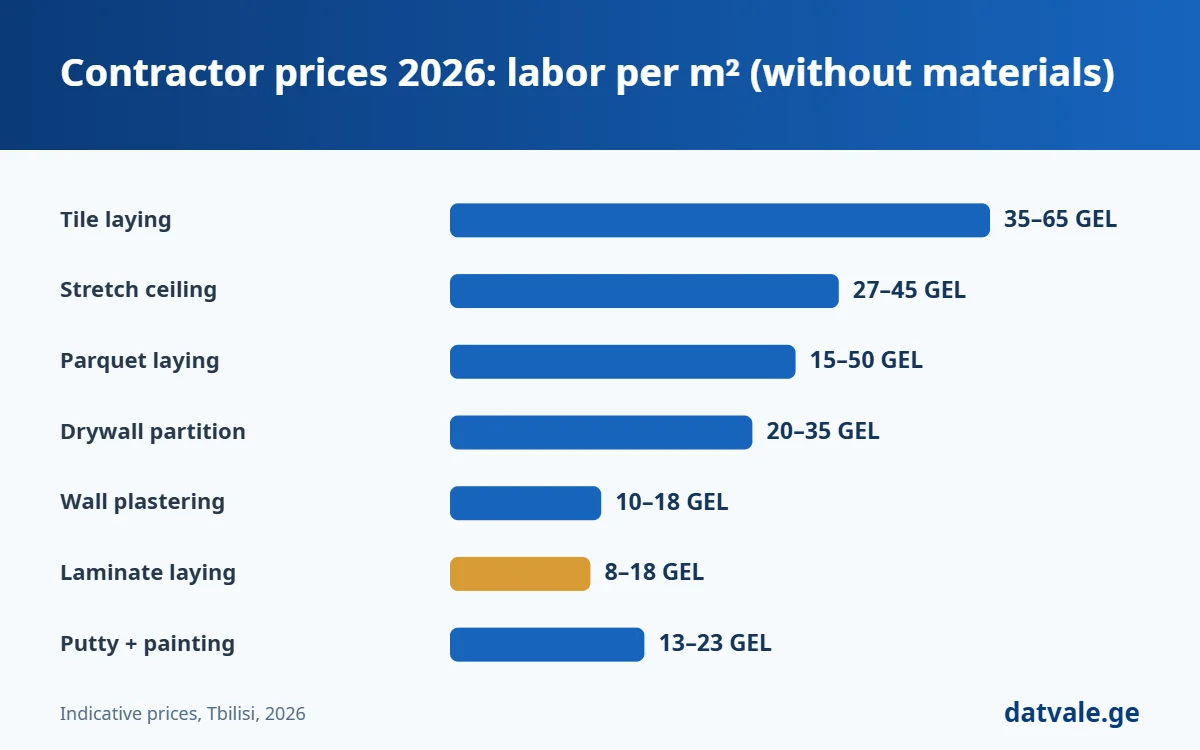
These figures are an average range. The lower end usually applies to simple, large and straight surfaces, and the upper end to complex, small or uneven ones. If a quote is far above this range, ask why. Sometimes the reason is objective, such as large-format tiles or a complex design; sometimes it is simply an attempt to see what you will accept.
Two contractors can quote prices that differ by a factor of two for the same job, and both can be right: a contractor price depends on many things. What matters is understanding what drives the difference, so you can tell a fair quote from a future contractor price increase.
Laying tiles on an uneven wall takes far more time and material than on a pre-leveled one. That is why a good contractor always visits the site before quoting. If you get a price over the phone without anyone seeing the apartment, that number will almost certainly change.
On a large project, a contractor is willing to quote a lower price per m² because the work is guaranteed for several weeks. On small jobs, such as tiling 3 m², they often charge a minimum fee, which works out very expensive per square meter.
Diagonal laying, mosaics, niches, hidden curtain rails and curved shapes all raise the price by 20–50%. This is normal, but you should know about it in advance, not at the end of the job.
Demand peaks in spring and late summer, so good contractors have waiting lists and higher prices. In winter, some jobs, such as interior finishing, can be agreed 10–15% cheaper.
Some contractors include buying and delivering materials in their price, others do not. An offer that looks more expensive may actually be cheaper if it also covers transport and waste removal.
A contractor who offers a warranty and shows you a portfolio is usually more expensive. That extra cost is often far cheaper than redoing badly done work.
The most common mistake is comparing quotes by the final figure alone. You can only compare contractor prices when all three quotes cover exactly the same work. Here is a real example for tiling a 5 m² bathroom (22 m² of walls and floor):
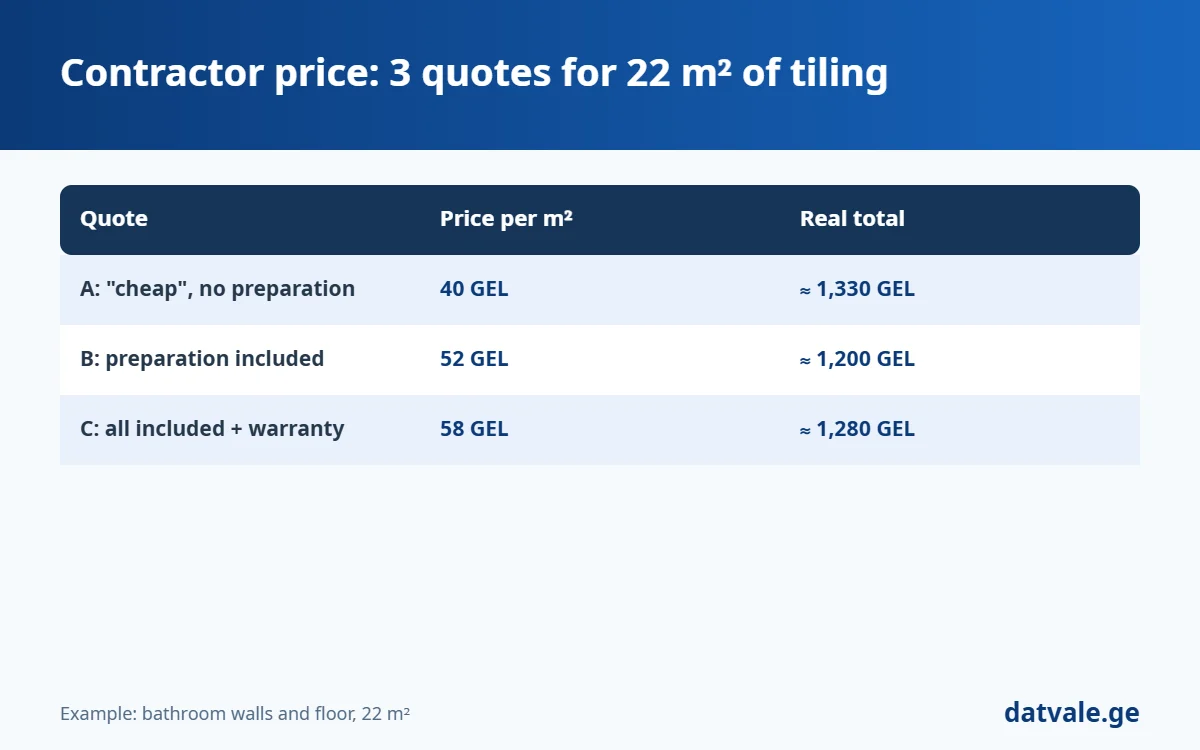
As you can see, the “cheapest” offer turned out to be the most expensive in the end, because preparation, waterproofing and grout were not included. This is exactly how trick no. 1 works. So before comparing, give all three contractors the same list of jobs and ask them to price each item separately.
Some signals are visible during the negotiation itself. If you notice two or more of the following, a contractor price increase during the project is very likely.
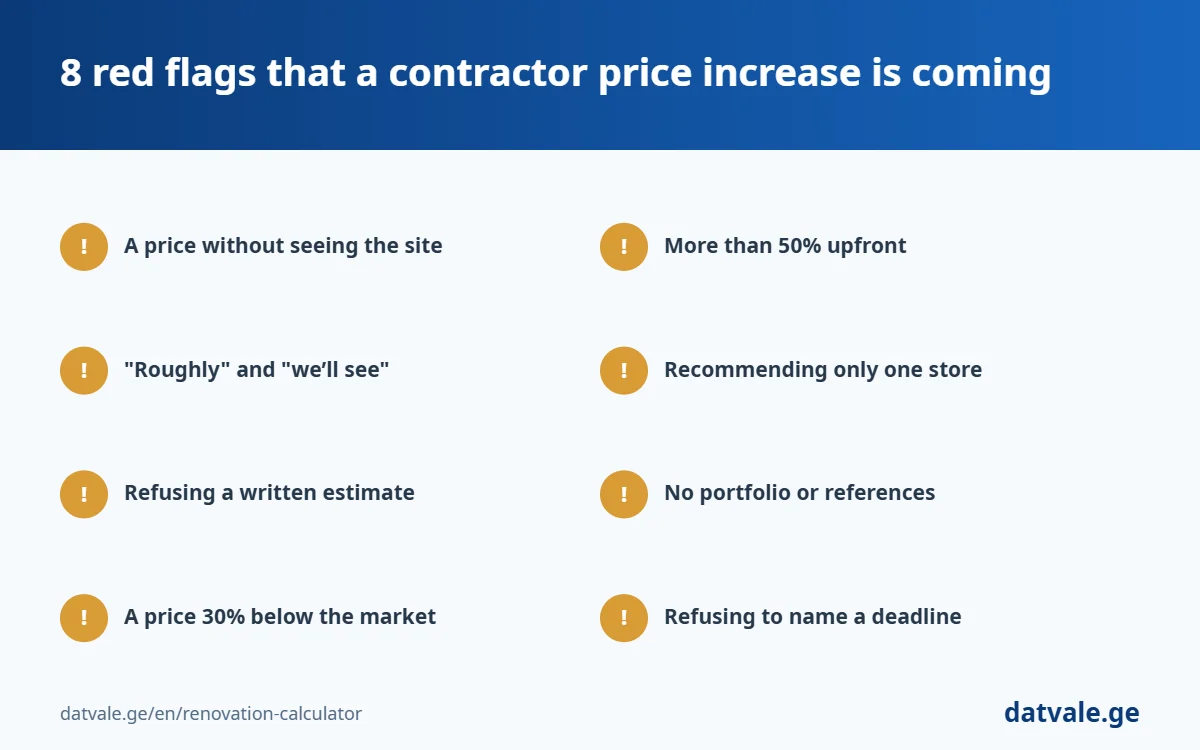
A contract does not need to be long or complicated. One or two pages where the price and terms are clearly set out are enough. At a minimum, it should include:
Even a simple written agreement is far better than a verbal one. An estimate sent and confirmed in a messenger app is important evidence if there is ever a dispute about a contractor price increase.
An individual contractor is usually 15–25% cheaper than a renovation company. On the other hand, a company often coordinates all the trades itself, controls deadlines, gives an official warranty and signs a formal contract.
For a small job, such as one bathroom or repainting, an individual contractor is completely sufficient. For a full renovation from black or white frame when you cannot be on site often, a company or a technical supervisor often pays for itself, because one contractor’s delay holds up every stage that follows.
In Saburtalo, Tbilisi, an apartment owner verbally agreed on 40 GEL per m² for bathroom tiling. For 22 m² of walls and floor, that should have been 880 GEL. After work started, the contractor added wall leveling (180 GEL), waterproofing (120 GEL), 45-degree tile cutting at the corners (90 GEL) and grout (60 GEL). In the end, the price became 1,330 GEL, about 50% more.
Formally, the contractor was not lying: all of this work really was needed. The problem was that it was never clear from the start what the 40 GEL included. If the agreement had been written and detailed, the owner would either have chosen another offer or at least planned the budget in advance.
Not every price increase is a trick. There are situations where a contractor price increase is justified, and arguing about it will only damage the relationship. The key is to tell these situations apart from tricks.
In all of these cases, one rule applies: any new price must be agreed in advance and in writing, before the work is done, including any new contractor price. If a contractor does the work first and tells you the price afterwards, that is already a problem.
If a contractor answers these questions calmly and specifically, that is a good sign. If they get irritated or avoid answering, think twice about working with them, however attractive the contractor price may be.
Finding a good contractor is often harder than choosing materials. The best source is still a recommendation: friends, relatives or neighbors who recently finished a renovation. That way you can see the finished work with your own eyes and ask whether there was a contractor price increase along the way.
Be more careful with contractors found on social media and classified sites: ask for photos of real projects, not just pictures from the internet, and ideally visit one of their previous sites in person. On Datvale‘s partners page you can also find verified companies and stores.
If you do not know a contractor, start with a small, clearly defined job, such as plastering one room or tiling the bathroom floor. You will see their quality, punctuality and whether they stick to the agreed contractor price. If all goes well, you can move on to the larger job.
Many owners try to push the contractor price as low as possible while not saving on materials. In practice, the opposite is often better. Expensive tiles look worse in the hands of a bad contractor than mid-range tiles in the hands of a good one. Installation quality, meaning straight joints, an even surface and precise corner cuts, is what you see every day.
So if your budget is limited, negotiate less on labor and save on materials instead: choose mid-range tiles with accurate geometry, compare prices across several stores and use partner discounts. The end result will be better than with expensive materials and cheap labor.
If you cannot visit the site often, agree with the contractor that they will send a few photos or a short video at the end of each working day. This is not a sign of distrust; it is normal professional practice that good contractors are happy to accept. Photos show you how much work was really done, and if the contractor later reports a “hidden problem”, you have visual material to check whether it really existed and whether the contractor price increase is fair.
Be sure to photograph pipes and wiring before the walls are closed (with a tape measure in the frame), bathroom waterproofing before tiling, the floor screed and the walls after putty. This photo archive will also be valuable after the renovation, when you need to drill a hole or add a socket.
These five rules need no special knowledge or much time, but in practice they are what separates a renovation that finishes within budget from one that turns into surprise costs and disputes.
Calculate materials and labor in advance — you’ll spot any overcharge immediately.
On a well-planned project, the increase should not exceed 10%. A 20–30% increase is usually the result of a vague agreement.
In most cases a fixed price for the scope of work is safer, because the risk of delays shifts to the contractor.
Usually 10–30%, with the rest in stages. It’s better to buy materials yourself.
Ask for 2–3 quotes for the same job and compare them with the result of the Datvale calculator.
The main job per unit. Preparation, waterproofing, grout, material delivery and waste removal are often extra, so always confirm in writing.
Yes, especially on a large project or in winter. But a very low price is often achieved at the expense of quality or the timeline.
Stop payments, document the completed work with photos and, under your agreement, ask for any overpayment back. For large sums, consult a lawyer.