


- EN
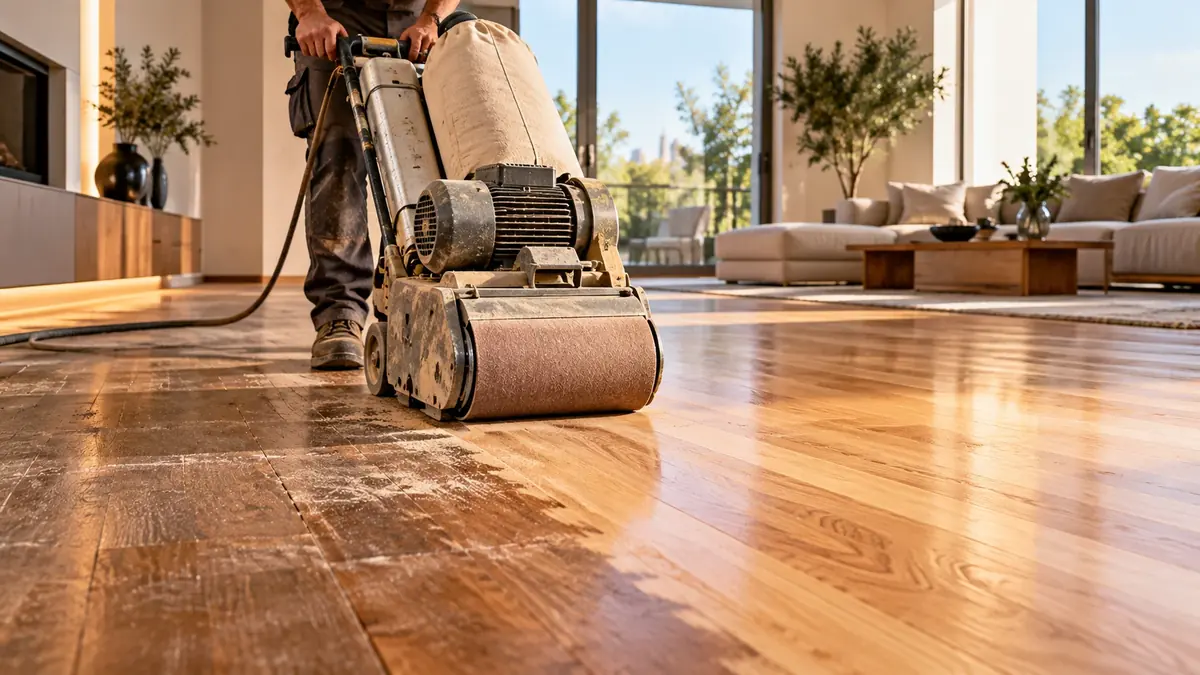
Parquet restoration often costs only a small fraction of the price of a new floor, and the result looks almost like new.
Wooden parquet is one of the most durable floors, but after years of use it develops scratches, stains and worn varnish. Instead of laying a new floor, sanding (cycle scraping) is often enough: removing the top layer and applying a new finish. In this article we explain when a floor needs sanding, how it is done step by step and what to keep in mind.
📌 To calculate the cost: floor sanding price calculator.
💡 Solid parquet can be sanded 5-8 times over its lifetime, while three-layer parquet can be sanded 1-3 times, depending on the thickness of the top layer. Laminate cannot be sanded.
| Varnish | Oil | |
|---|---|---|
| Durability | High, withstands water | Medium, needs periodic refreshing |
| Look | Glossy / semi-matte | Natural, matte |
| Repair | Must be redone entirely | Can be done locally |
| Best for | Kitchen, hallway | Bedroom, living room |
In a 50-60 m² apartment the work usually takes 2-4 days, and the varnish needs 5-7 days to dry fully before you can bring the furniture back and lay a rug.
The price depends on the area, the condition of the floor and the type of finish. Calculate it with the floor sanding price calculator. For proper floor care after sanding, see the floor care calculator, and if a new floor is the better option, use the parquet calculator.
If the boards are solid, do not move, and the top wood layer is thick enough, parquet restoration is always the better choice: less waste, less time and significantly lower cost. A new floor is the better option when the boards are rotting, deformed by moisture, or when the top layer of three-layer parquet is already worn through.
You can read about the history and types of wooden flooring here. And after properly done parquet restoration, with regular care, the floor will serve you for another 10-15 years.
Before sanding, it is essential to secure all loose boards, eliminate squeaking and replace damaged boards. If the floor squeaks, injecting glue under the board or adding an extra nail is often enough. A worn-down board must be replaced with wood of exactly the same species so that the color does not differ.
The first, rough pass removes the old varnish and unevenness. The second levels out scratches, and the third prepares the surface for varnishing. Corners and wall edges are treated with a special edge sander. After each pass, the dust must be removed completely.
The primer prepares the wood and controls how much varnish it absorbs. Then 2-3 coats of varnish are applied, with light intermediate sanding between the coats. Water-based varnish is almost odorless and dries quickly, while polyurethane varnish is more durable for high-traffic areas.
| Species | Hardness | After sanding |
|---|---|---|
| Oak | High | Takes finish beautifully, the most popular |
| Ash | High | Light, with a distinct grain |
| Beech | Medium | May leave blotches when stained |
| Walnut | Medium | Dark, luxurious look |
After sanding, you can change the color with tinting or oil: oak easily takes both light Nordic and dark tones.
For a detailed cost estimate, see the floor care calculator.
In an old 70 m² apartment, the oak parquet was worn and stained, and the owner was planning to lay laminate. An inspection showed that the boards were solid and the top layer was thick enough. The parquet restoration (repairs, three-pass sanding, primer and three coats of matte varnish) took 4 days and cost about a third of what a new floor would have. The result: natural oak that will last another 15 years.
📹 Video renovation tips: Datvale YouTube · 👍 News and discounts: Datvale Facebook
Solid parquet 5-8 times and three-layer parquet 1-3 times, depending on the thickness of the top layer.
No. Laminate has no top wood layer, so it cannot be sanded.
You can walk on it after 24 hours, bring the furniture back in 3-5 days and lay a rug after 7 days.
If the boards are solid and the top layer is sufficient, sanding costs only a small fraction of the price of a new floor.