


- EN
A renovation budget of 20,000 GEL — is it enough for a 60 m² apartment in Georgia in 2026? It is one of the most common questions apartment owners ask. The answer depends on the condition of the apartment, the quality of materials and how carefully you plan your expenses.
In this article we use a real example to show where every lari goes, what you can actually get for 20,000 GEL and where you can save money without sacrificing quality.
Renovation prices in Georgia depend mainly on the starting condition of the apartment. The closer you start to “zero”, the more work is needed and the higher the cost. Approximate prices for 2026 look like this:
| Apartment condition | Price per m² (economy–standard) | 60 m² apartment |
|---|---|---|
| Black frame | 400–900 GEL | 24,000–54,000 GEL |
| Green frame | 350–700 GEL | 21,000–42,000 GEL |
| White frame | 300–550 GEL | 18,000–33,000 GEL |
| Cosmetic renovation | 150–280 GEL | 9,000–16,800 GEL |
The table shows that 20,000 GEL is realistic for an economy-class renovation from white frame, while for a cosmetic renovation some money will even be left for furniture and appliances.
Let’s take a 60 m² two-bedroom apartment in white frame: walls and floor screed are ready, and the electrical wiring is done. In the economy-standard class, the renovation budget is split roughly like this:
| Work | Materials + labor | Share |
|---|---|---|
| Heating: boiler + 5 radiators + installation | ≈ 4,000 GEL | 20% |
| Bathroom: tiles, sanitary ware, installation | ≈ 4,200 GEL | 21% |
| Walls and ceiling: putty, paint | ≈ 3,500 GEL | 17.5% |
| Flooring: laminate + skirting | ≈ 3,300 GEL | 16.5% |
| Interior doors (4 pcs) | ≈ 1,800 GEL | 9% |
| Electrical finishing: sockets, lighting | ≈ 1,200 GEL | 6% |
| Reserve for unexpected costs | ≈ 2,000 GEL | 10% |
| Total | ≈ 20,000 GEL | 100% |
Note: this budget does not include kitchen furniture, appliances or soft furniture. These often add another 5,000–10,000 GEL, so decide in advance whether you include them in the renovation budget or plan them separately.
When your renovation budget is just one big number on paper, it is very easy to lose control of it. It works much better to split the money by room. That way you can see exactly which space “eats” the most money and where you can afford to compromise. Below is a typical breakdown for a 60 m² two-bedroom apartment renovated from white frame.
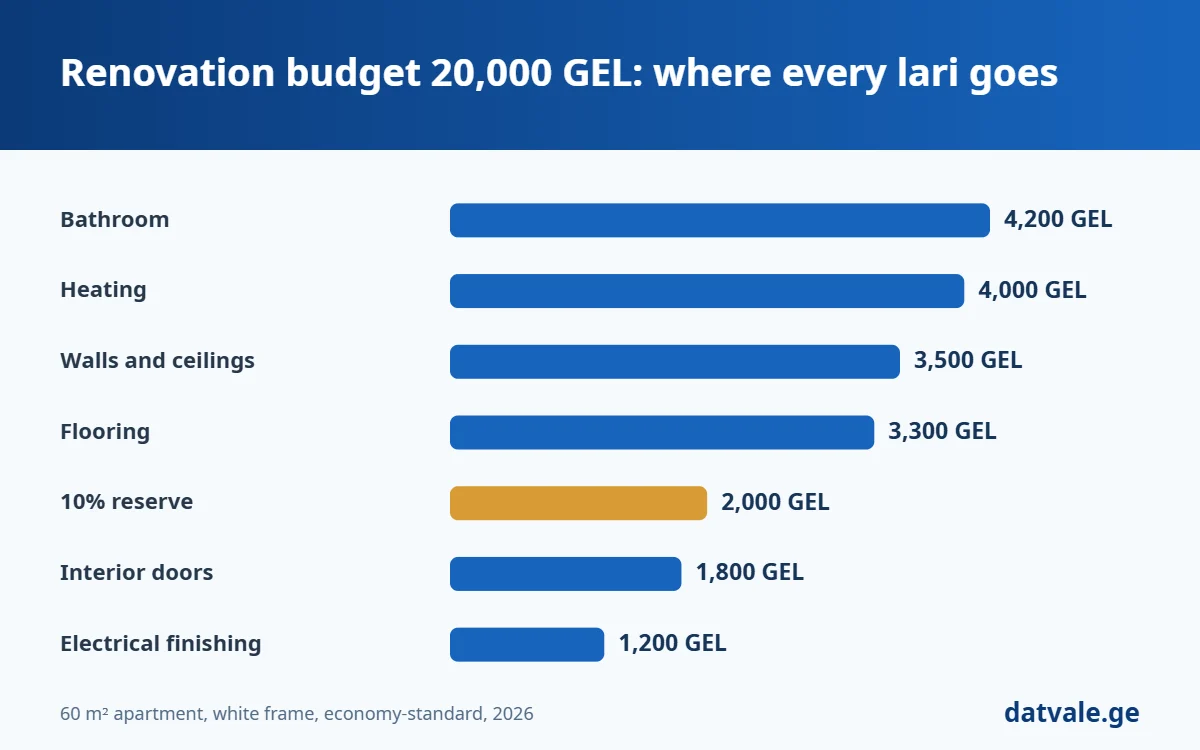
The bathroom is only 6–8% of the apartment’s floor area, yet it takes almost one fifth of the renovation budget. The reason is simple: this is where floor and wall tiles, waterproofing, plumbing points, the toilet, sink, shower or bathtub, mixers and ventilation all come together. In the economy class, a 4–5 m² bathroom costs roughly 3,800–4,500 GEL. If you choose a wall-hung toilet, large-format tiles and a walk-in shower, that figure can easily pass 7,000 GEL.
In the kitchen, the renovation budget should be split into two parts. The first part is the construction work: leveling the walls, the tiled backsplash, sockets, lighting and flooring. This is about 1,200–1,800 GEL. The second part is kitchen furniture and appliances, which range from 3,000 to 12,000 GEL. That is exactly why we listed furniture separately in the table: if you include it in the renovation budget, 20,000 GEL will clearly not be enough.
In living spaces, the main costs are wall putty, painting and flooring. Preparing and painting 1 m² of wall twice costs about 22–30 GEL in the economy class, including labor and materials, while 1 m² of laminate with skirting and installation costs 45–60 GEL. So despite their size, these rooms are the most predictable part of the renovation budget.
In the hallway, people often forget the entrance door reveals, the wardrobe niche, extra lights and a mirror. Each is cheap on its own, but together they come to 600–1,000 GEL. If you do not write this down in advance, the money will automatically come out of your reserve.
The same 60 m² apartment can cost three times as much to renovate depending on the choices you make. The difference is mostly in the class of materials: laminate thickness, tile format, plumbing brand, door type and the ceiling solution. Labor costs also rise, because expensive materials require more precise and slower installation.
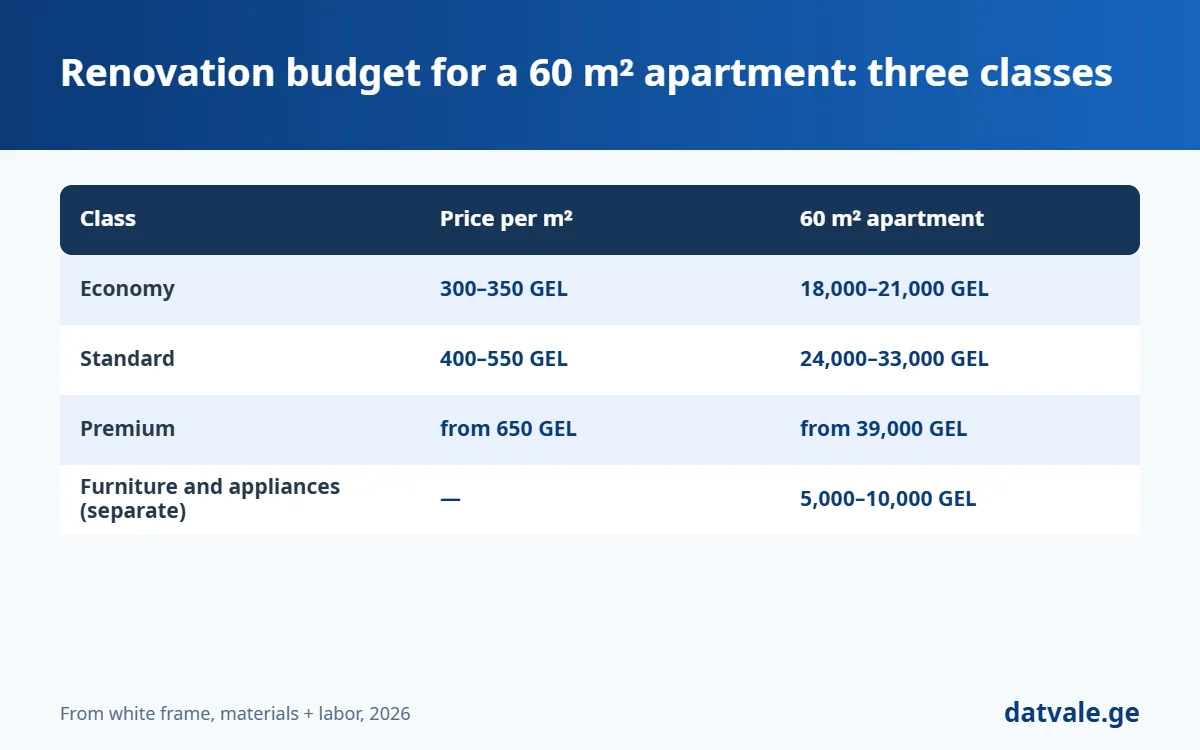
In our experience, most apartment owners choose the “standard” class, but plan their renovation budget around the “economy” class. This is the most common reason a renovation stalls halfway. Before you pick materials, decide which class you are in and stay in it in every room.
A renovation budget is not only about “how much”; it is also about “when”. The money is not spent all at once, and if you plan the payment schedule in advance you will feel much less stress. In a 60 m² apartment where the renovation takes 2–3 months, spending is distributed roughly like this:
The main advantage of this schedule is that you can see when you will need the most cash. If your renovation budget is partly financed by a loan or installments, you should already have the money for the first two stages in hand.
In Georgia, labor makes up on average 35–45% of an economy-standard renovation, and materials 55–65%. The ratio changes with the type of work: putty and painting are labor-heavy, while plumbing and heating are material-heavy. In a 20,000 GEL renovation budget, that is roughly 8,000 GEL of labor and 12,000 GEL of materials.
There are three main ways to pay for labor: a fixed price per square meter, a fixed price for the whole project, and a daily rate. To keep your renovation budget under control, the first two are the safest, because with a daily rate you do not control how long the job takes, and therefore its price. We cover this topic in detail in our article Contractor price increase: 7 tricks.
Every major job shows up in a cost estimate, but there are expenses that almost always get missed. These are the ones that push the final total up by 10–15%:
This list shows why a 10% reserve is an essential part of the renovation budget and not a luxury.
A well-prepared renovation budget takes one evening, but it protects you from overspending for months. Here are the 8 steps we use on every project:
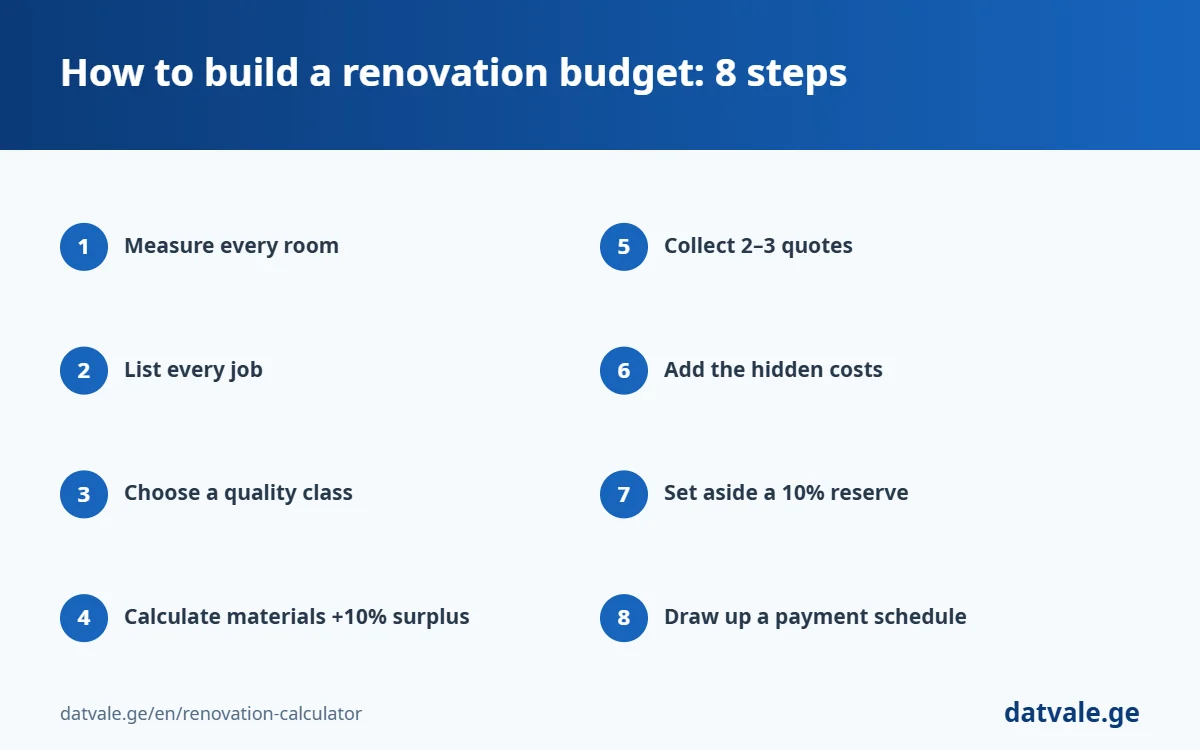
Most of this process is done automatically in Datvale’s renovation calculator: you enter the area, rooms and class, and the calculator works out material quantities and labor prices for you.
If you are renovating an old Soviet-era apartment instead of a new building, the renovation budget has to be planned differently. You often need to remove old tiles and plaster, replace all the wiring, change old pipes and upgrade the windows. Demolition alone costs 1,500–3,000 GEL for 60 m², including waste removal.
That is why 20,000 GEL is realistic in an old apartment only if the wiring and pipes have already been replaced and only cosmetic and surface work is needed. Otherwise, plan for 25,000–30,000 GEL or split the work into stages.
Take a typical case: a young family bought a 60 m² apartment in white frame in Vake. Their renovation budget was 20,000 GEL. First they did the heating and the bathroom in the standard class, because that is everyday comfort and very hard to change later. In the bedrooms and hallway they chose economy-class laminate and paint, and they bought the kitchen furniture separately six months later.
Thanks to discounts at partner stores they saved about 1,400 GEL on materials, and only 1,100 GEL of the reserve was spent. In the end, the renovation budget closed at 19,700 GEL. This example shows that even a limited amount is enough if your priorities are set in advance.
For many families, the renovation budget is not funded by savings alone. In Georgia the three most common options are your own savings, a consumer or renovation loan, and buying materials in installments at partner stores. Each has its own advantages and risks.
This is the cheapest and most flexible option: you pay no interest and control the pace of work yourself. The downside is that saving up takes time, and material prices may rise in the meantime. If you already have 60–70% of the renovation budget, it often makes sense to start with the hidden work and add the rest gradually.
A loan lets you finish the renovation quickly in one go, but the final cost grows by the amount of interest. Before borrowing, calculate the monthly payment and compare it with the rent you pay while the renovation is underway. If finishing sooner saves you several months of rent, a loan can make financial sense.
Many building supply stores offer interest-free or low-interest installments. This is a good way to buy expensive items such as a boiler, radiators, plumbing or flooring on time and spread the renovation budget over several months. Read the terms carefully: sometimes discounts do not apply when you pay in installments.
We are often asked how the renovation budget changes if the apartment is smaller or larger. Simple proportion does not work here: every apartment has a bathroom, a kitchen and a heating system, and their cost depends less on floor area. That is why the price per m² is higher in a small apartment and relatively lower in a large one.
If you can say “yes” to every item on this list, your renovation budget is realistic and it is safe to start. If you have doubts about any point, it is better to delay the start by a week and clarify everything than to have to stop in the middle of the work.
20,000 GEL is a realistic amount for a 60 m² apartment if it is in white frame, you choose the economy-standard class and you plan furniture separately. Three things decide whether your renovation budget closes successfully: a detailed estimate by room, a 10% reserve and a payment schedule by stage. Save on decor, never on hidden work, compare materials across several stores, use partner discounts and record every expense.
The figures above are approximate. The exact cost of your apartment depends on the area, number of rooms and bathrooms, and the quality you choose. So before you start, use the renovation calculator — in a few minutes you’ll get a detailed estimate of materials and labor.
To follow price trends, the construction materials price data published by Geostat is also useful.
Enter the apartment area and condition — the calculator will show how much renovation costs in economy, standard and premium class.
For an economy renovation from white frame — yes. A full renovation from black frame needs about 24,000 GEL or more.
On average 35–45%. The rest goes to materials. The exact ratio depends on the complexity of the work.
Decor, curtains, some light fixtures and soft furniture. Hidden work (plumbing, electrics, waterproofing) must be done right from the start.
Material and labor prices rise every year, so always use current prices and a calculator when planning your budget.
From white frame, about 300–350 GEL in the economy class, 400–550 GEL in the standard class and from 650 GEL in the premium class.
It is better to plan it separately. Kitchen furniture and appliances add 5,000–10,000 GEL in a 60 m² apartment, and mixing them with construction work makes the budget harder to control.
Pause the decorative work and finish the hidden work, the bathroom and the flooring first. Decor and lighting can be added later.