


- EN
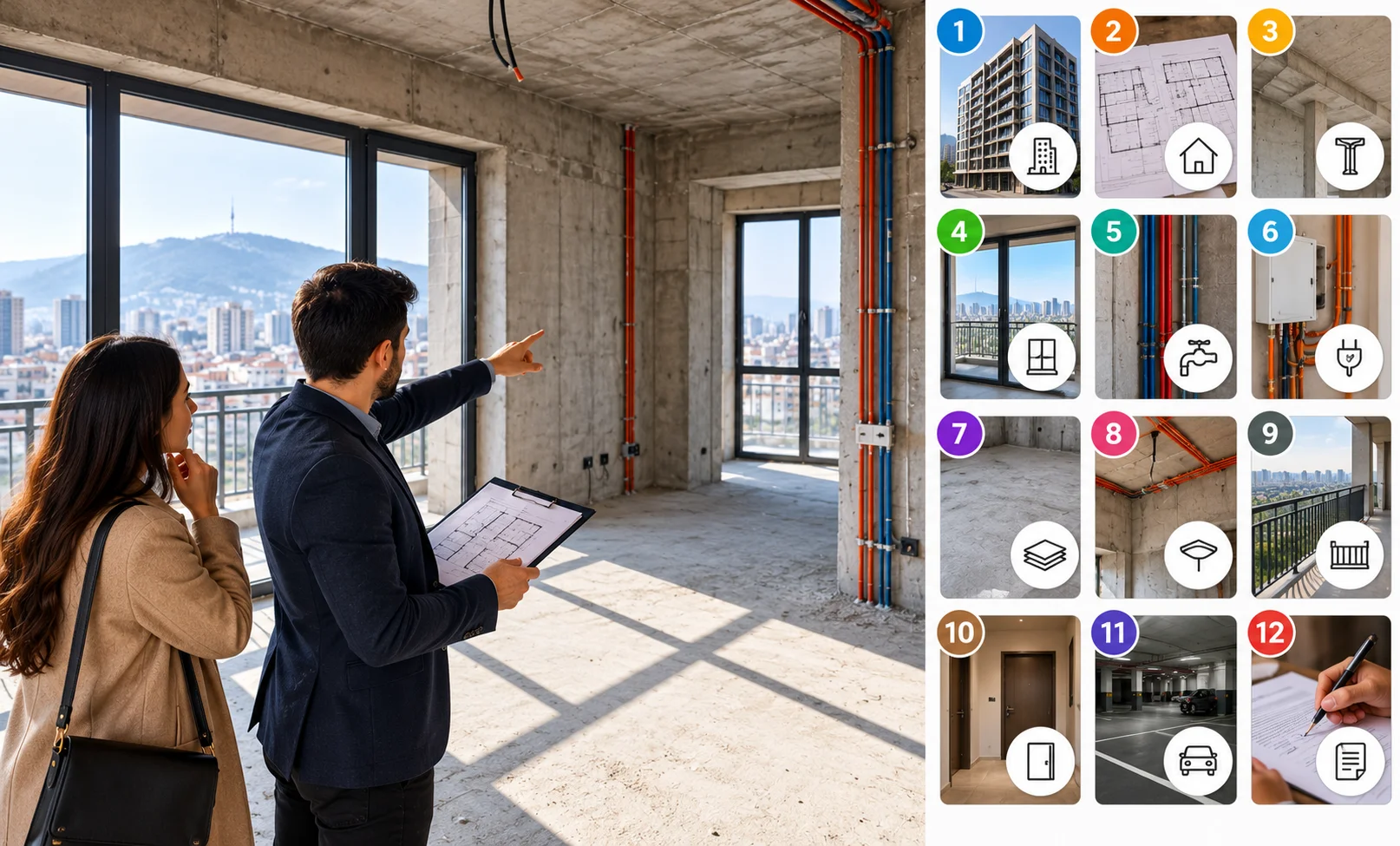
A black frame apartment handover is one of the most important moments when buying in a new building in Georgia. Once you sign the acceptance act, it becomes much harder to make the developer fix defects — and any unnoticed problems end up in your renovation budget.
This article gives you a 12-point checklist to go through before accepting a black frame apartment.
Measure every room and compare with the contract and floor plan. If the area is smaller than agreed, depending on the contract terms you may be able to request a price adjustment.
Check the ceiling height at several points. Remember that the floor screed and ceiling finish will reduce the height by another 8–15 cm.
Use a level to check the walls and corners. Very crooked walls mean extra plastering and higher costs during renovation.
Carefully inspect walls, ceilings and columns. A thin surface crack is often harmless, but wide or diagonal cracks need a specialist’s assessment.
If windows are included, check how they open and close, and look for gaps, damaged glass units or scratches.
Check the lock, hinges and how tightly the door closes. Collect all keys.
Find out whether a meter is installed and what power capacity is allocated to the apartment. If you plan underfloor or electric heating, low capacity will be a serious problem.
Check whether gas and water are connected, whether meters are installed and where the entry points are. This affects the layout of the kitchen and bathroom.
Locate the sewer riser and check that it is intact and undamaged. Moving a bathroom far from the riser is difficult and expensive.
Make sure the kitchen and bathroom have ventilation ducts and that they aren’t blocked with debris. Poor ventilation later causes dampness and mold.
Check the strength of the railing, the floor slope and water drainage. Standing water on a balcony causes damage over time.
Make sure the building has been commissioned and the apartment can be registered in your name. You can verify ownership data on the website of the National Agency of Public Registry.
Knowing the checklist matters, but so does how the handover day itself is organized. To make your black frame apartment handover calm and thorough, prepare in advance and work in a set order.
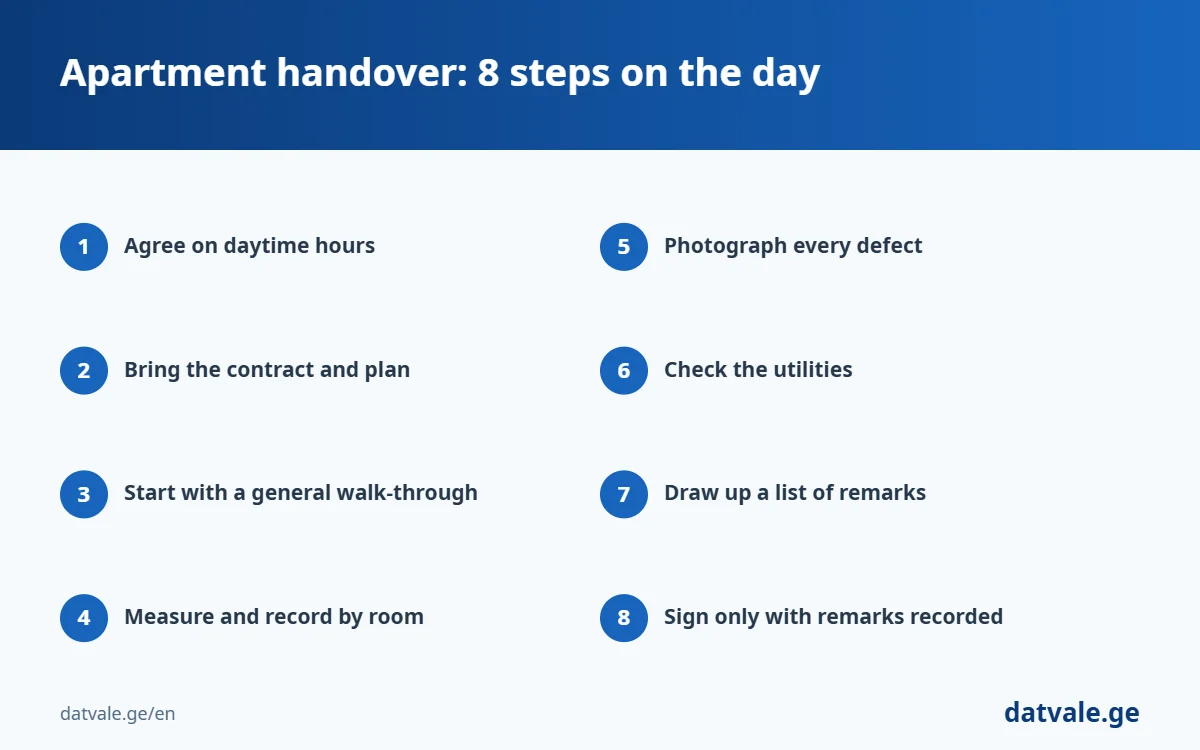
An apartment handover is not a formality to be finished in 15 minutes. If the developer’s representative rushes you, calmly explain that you need to check everything. That is your right and normal practice.
Nobody expects perfectly straight walls in a black frame apartment, since they will be plastered later anyway. But there is a limit above which deviations significantly increase renovation costs. Here are indicative norms you can use during the apartment handover:
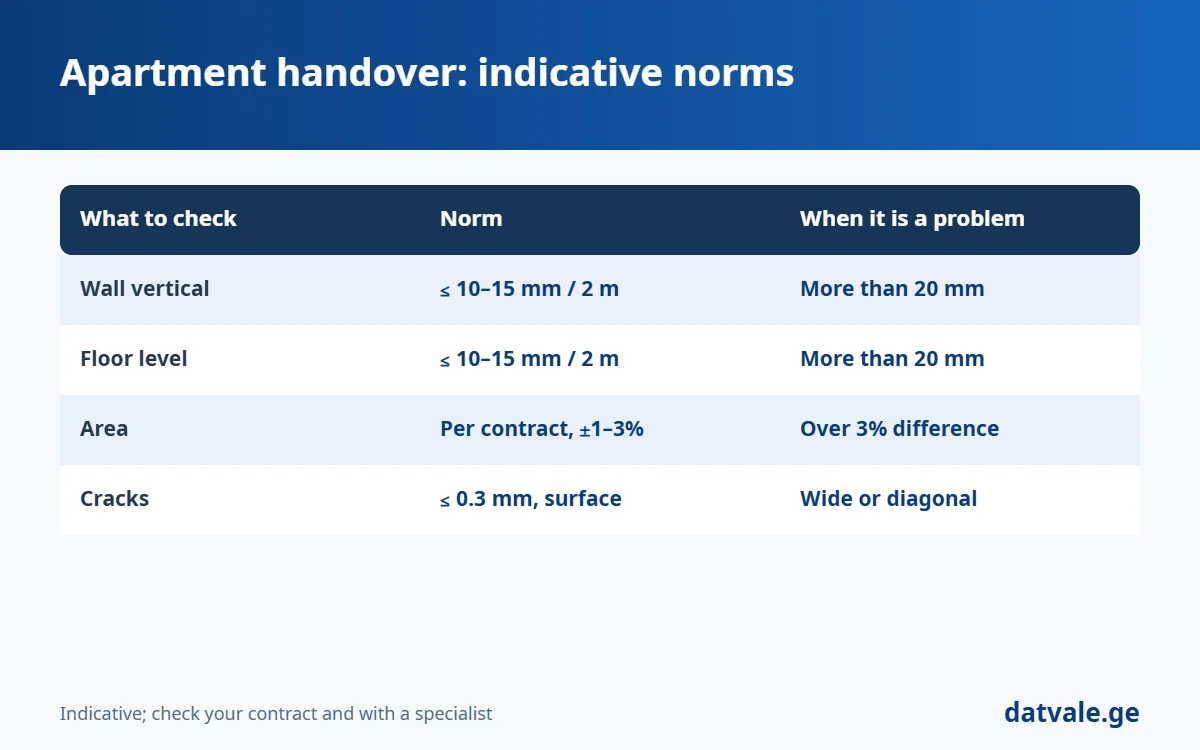
Exact norms depend on your contract and current building standards, so if a deviation is significant, have a specialist check it. The main principle is simple: the bigger the deviation, the more plaster, material and money you will need during the renovation.
Hold a 2-meter level or straight profile against the wall vertically and horizontally in several places. Measure the largest gap between the level and the wall with a ruler. A laser level gives an even more accurate picture: it projects a straight line across the whole wall so you can measure the distance from it anywhere.
If you do not record a defect during the apartment handover and the developer does not fix it, the repair comes out of your renovation budget. Here are indicative costs for fixing the most common problems:
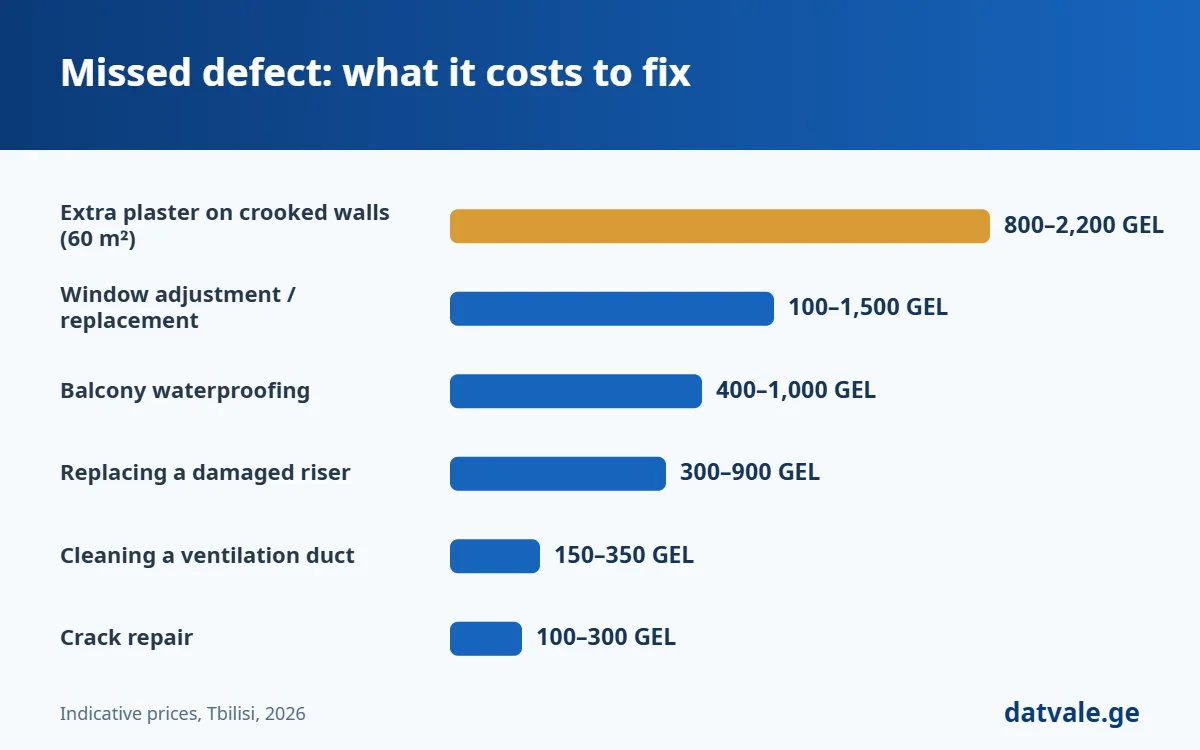
These figures show why it is worth spending an hour or two on the apartment handover: even one recorded defect that the developer fixes can save you hundreds or thousands of lari.
The list of defects drawn up during the apartment handover should be specific and clear. A general phrase like “the walls are crooked” means almost nothing. A proper entry looks like this: “Bedroom 1, wall opposite the window: vertical deviation of 25 mm over 2 meters, photo no. 7”.
If the developer refuses to record remarks in the act, prepare a separate written document with photos and send it officially, by email or registered letter, so the sending date is confirmed.
Area is one of the most important points of the apartment handover, because the price is tied directly to square meters. A 2 m² difference at 1,500 GEL per square meter is already 3,000 GEL.
When measuring, check how the contract calculates area. Some developers count the balcony in full, some with a coefficient, and some include part of the wall thickness. So first see which method the contract uses, then measure the same way.
If the area is significantly smaller, be sure to record this in the act. Many contracts provide for a partial refund or a reduced final payment in exactly this case.
Photos and videos taken during the apartment handover serve two purposes. First, they are evidence of defects if a dispute arises with the developer. Second, they are the “starting map” of your apartment, which will be very useful when planning the renovation.
The season also affects the apartment handover. In winter or rainy periods, leaks from the roof, balcony and windows are easier to spot, as are damp patches on walls. In summer, ventilation and overall condition are easier to assess, but some leaks may go unnoticed. If possible, visit the apartment once after rain before the handover.
Many buyers do the handover themselves, and that is perfectly possible if you follow the checklist carefully. But in some cases bringing a specialist (an engineer, technical supervisor or experienced contractor) clearly pays off:
A specialist usually costs 100–300 GEL, which is negligible compared with the apartment price. One serious defect that goes unnoticed can cost thousands during the renovation.
Key rule: do not start renovating areas where a defect is in dispute until it is properly documented, or the evidence may be lost.
Our article Renovation budget of 20,000 GEL will help with the budget, and Apartment renovation timeline with the schedule.
A 72 m² apartment in Isani, in a new building. The buyer came to the apartment handover with a checklist, a laser distance meter and a level. Re-measuring showed the apartment was 1.8 m² smaller than the contract stated. In one bedroom the wall deviation reached 30 mm, and on the balcony water pooled toward the wall instead of draining.
All defects were recorded with photos and measurements in an annex to the act. The developer deducted the area difference from the final payment (about 2,700 GEL), fixed the balcony slope and waterproofing, and plastered the crooked wall. By the buyer’s estimate, a careful apartment handover saved over 4,000 GEL in total, for a two-hour inspection.
An apartment handover is not just a formal signature; it is your last and best chance to have the developer fix defects at their expense. Prepare in advance, bring measuring tools, go through the 12-point checklist, photograph and record everything, and sign the act only with your remarks included. The hour or two you spend on a black frame apartment handover will save you thousands of lari and a lot of stress during the renovation.
Many people think the apartment handover and renovation planning are two separate stages. In reality, the information you collect at the handover is the best starting data for your renovation. Precise measurements, wall deviations, utility entry points and photos will all be useful when working with a designer, contractors and when preparing the cost estimate.
For example, if the apartment handover shows wall deviations of 20–30 mm, the plaster layer will be thicker and you will need more material. If the electrical capacity is low, you need to increase it before planning electric underfloor heating. If the sewer riser is in a corner of a room, the bathroom and kitchen layout must be planned around it.
So keep the results of the apartment handover in one file: measurements by room, photos, defects found and their status. Share it with your designer and contractors so they can quote accurate prices and there are fewer surprises during the work. In Datvale‘s renovation calculator you can turn this data into an indicative estimate for a black frame renovation in just a few minutes.
If you carried out the apartment handover properly, you will already have answers to all of these questions.
Once you’ve accepted the apartment, the next step is planning the renovation. In 2026, renovation from black frame costs on average 400–900 GEL per square meter, depending on quality. For a 60 m² apartment, that’s 24,000–54,000 GEL.
| Quality | Price per m² | 60 m² apartment |
|---|---|---|
| Economy | 400–600 GEL | 24,000–36,000 GEL |
| Standard | 600–900 GEL | 36,000–54,000 GEL |
| Premium | 900–1,500 GEL | 54,000–90,000 GEL |
Every defect found during the handover that the developer didn’t fix adds to this budget. That’s exactly why the checklist is worth going through carefully.
Enter the apartment area and choose the quality — get a detailed estimate of materials and labor.
A black frame apartment has the load-bearing structure, often an entrance door and windows, but no partitions, plaster, screed or wiring.
If the apartment doesn’t match the contract, you can record your remarks and request fixes. Your specific rights depend on the contract.
Yes, especially if you notice cracks or damp spots. A consultation with an engineer or experienced builder can save you a lot later.
A careful inspection of a 60–80 m² apartment takes about 1–2 hours. Don’t rush.
A tape measure or laser distance meter, a 2-meter level or laser level, a flashlight, a phone for photos and a copy of the contract with the floor plan.
Record everything in writing and with photos, send an official request and, if needed, consult a lawyer. Your rights depend on the contract.
Contracts often allow a small difference, for example 1–3%. If the difference is larger, you may be able to request a price adjustment under the contract.