


- EN
/* dv-lift */ .single-post .dv-blog{margin-top:-170px;position:relative;z-index:2} @media(max-width:1024px){.single-post .dv-blog{margin-top:-80px}}
/* DATVALE BLOG */
.dv-blog,.dv-blog *{box-sizing:border-box}
.dv-blog{
width:100%;max-width:1100px;margin:0 auto;
color:#26384a;font-family:system-ui,-apple-system,
BlinkMacSystemFont,”Segoe UI”,sans-serif;
font-size:17px;line-height:1.75;
}
.dv-blog h2{
margin:42px 0 14px;color:#173558;
font-size:28px;line-height:1.3;font-weight:850;
}
.dv-blog h3{
margin:28px 0 10px;color:#173558;
font-size:21px;line-height:1.35;font-weight:800;
}
.dv-blog p{margin:0 0 18px}
.dv-blog ul,.dv-blog ol{
margin:10px 0 22px;padding-left:24px;
}
.dv-blog li{margin-bottom:9px}
.dv-blog a{
color:#0b5dab;font-weight:700;text-decoration:none;
}
.dv-blog a:hover{text-decoration:underline}
.dv-blog .dv-lead{font-size:19px}
.dv-blog .dv-banner{
position:relative;overflow:hidden;width:100%;
height:215px;margin:0 0 30px;border-radius:22px;
background:#eef1f4;
}
.dv-blog .dv-banner img{
display:block;width:100%;height:100%;margin:0;
padding:0;border:0;object-fit:cover;
object-position:center;image-rendering:auto;
}
.dv-blog .dv-info{
margin:28px 0;padding:20px 22px;
border:1px solid #dce7f2;border-radius:16px;
background:#f6f9fd;color:#425a74;
}
.dv-blog .dv-warning{
margin:28px 0;padding:20px 22px;
border-left:4px solid #d79b35;
border-radius:12px;background:#fffaf0;
}
.dv-blog .dv-cta{
margin:34px 0;padding:26px;border-radius:18px;
background:linear-gradient(135deg,#0b3a78,#1764bd);
color:#ffffff;
}
.dv-blog .dv-cta h3{
margin:0 0 10px;color:#fff;font-size:23px;
}
.dv-blog .dv-cta p{
margin:0 0 18px;color:rgba(255,255,255,.92);
}
.dv-blog .dv-cta a{
display:inline-flex;align-items:center;justify-content:center;
padding:12px 18px;border-radius:10px;background:#fff;
color:#0b3a78;font-size:15px;font-weight:850;
text-decoration:none;
}
.dv-blog .dv-cta a:hover{
background:#e9f2ff;text-decoration:none;
}
.dv-blog .dv-table-wrap{
margin:25px 0 30px;overflow-x:auto;
border:1px solid #dce7f2;border-radius:15px;
}
.dv-blog table{
width:100%;min-width:580px;border-collapse:collapse;
font-size:15px;line-height:1.55;
}
.dv-blog th{
padding:15px;background:#0b3a78;color:#fff;
text-align:left;font-weight:800;
}
.dv-blog td{
padding:15px;border-bottom:1px solid #e3ebf5;
vertical-align:top;
}
.dv-blog tbody tr:nth-child(even){background:#f7faff}
.dv-blog tbody tr:last-child td{border-bottom:0}
.dv-blog .dv-related{
margin:38px 0 25px;padding:24px;
border:1px solid #e1e9f3;border-radius:18px;
background:#f8fbff;
}
.dv-blog .dv-related h3{margin:0 0 15px}
.dv-blog .dv-related ul{margin-bottom:0}
.dv-blog .dv-faq{
margin:16px 0;padding:18px 20px;
border:1px solid #e1e9f3;border-radius:14px;
}
.dv-blog .dv-faq h3{
margin:0 0 10px;font-size:19px;
}
.dv-blog .dv-faq p{margin:0}
.dv-blog .dv-social{
margin-top:34px;padding-top:22px;
border-top:1px solid #e3ebf5;color:#526b84;
}
@media(max-width:900px){
.dv-blog .dv-banner{height:190px}
}
@media(max-width:700px){
.dv-blog{font-size:16px;line-height:1.7}
.dv-blog h2{margin-top:34px;font-size:23px}
.dv-blog h3{font-size:19px}
.dv-blog .dv-lead{font-size:17px}
.dv-blog .dv-banner{
height:183px;margin-bottom:24px;border-radius:14px;
}
.dv-blog .dv-cta,.dv-blog .dv-related,
.dv-blog .dv-info,.dv-blog .dv-warning{padding:18px}
.dv-blog th,.dv-blog td{padding:12px}
}
@media(max-width:380px){
.dv-blog .dv-banner{height:165px}
}
Renovating from abroad is a reality for many emigrants today: the apartment is in Georgia, while the owner works in another country and cannot be there in person. The good news is that with the right plan, written agreements and a clear budget, updating your apartment is possible even without being present throughout the whole process.
In this article you will learn how to start and manage a renovation from abroad so that you do not lose money or nerves. As a first step, calculate the expected cost: the renovation calculator shows you a budget with materials and labor details before you speak to a contractor.
This article complements our more general material on remote construction and renovation. If both topics interest you, read our article how to build a house or renovate an apartment in Georgia remotely. Here we focus on the specific situation of an emigrant: the time difference, trust, money transfers and control.
The main difficulty is not the distance itself, but the lack of information. When you are not at the site, you cannot see how a wall is being plastered, what materials are used or how long the work takes. As a result, small mistakes go unnoticed and eventually become expensive to fix.
So the goal is one: transfer as much as possible into a written form and add regular visibility. When every stage is documented, being physically present becomes almost unnecessary.
A well-prepared plan reduces uncertainty. A result, date and amount written down for each stage creates a situation where both sides know exactly what should happen and when.
For an emigrant, renovating from abroad is often the only option, because the apartment urgently needs updating for rental, sale or the family’s return. So when planning, define the main goal first: is the apartment for rent, for sale or for living in? This goal determines the quality of materials and the budget limit.
If you will rent the apartment out, affordable but durable materials are justified. If you plan to live there yourself, more comfortable solutions are worth considering. A goal defined in advance saves you from many unnecessary costs.
Before you call a contractor, you need to know how much you can spend and what you want in the end. Write a list: which rooms will be renovated, what quality of materials you prefer and what you leave for later.
This is where the renovation calculator helps. Enter the area, choose the quality level and get an estimate you can compare with the contractor’s offer. If the difference is large, it is a signal that the details need clarifying.
Always keep part of the budget for unforeseen expenses. Older apartments often hide problems: a pipe, wiring or a crooked wall. A clearly defined reserve keeps such situations from turning into a drama.
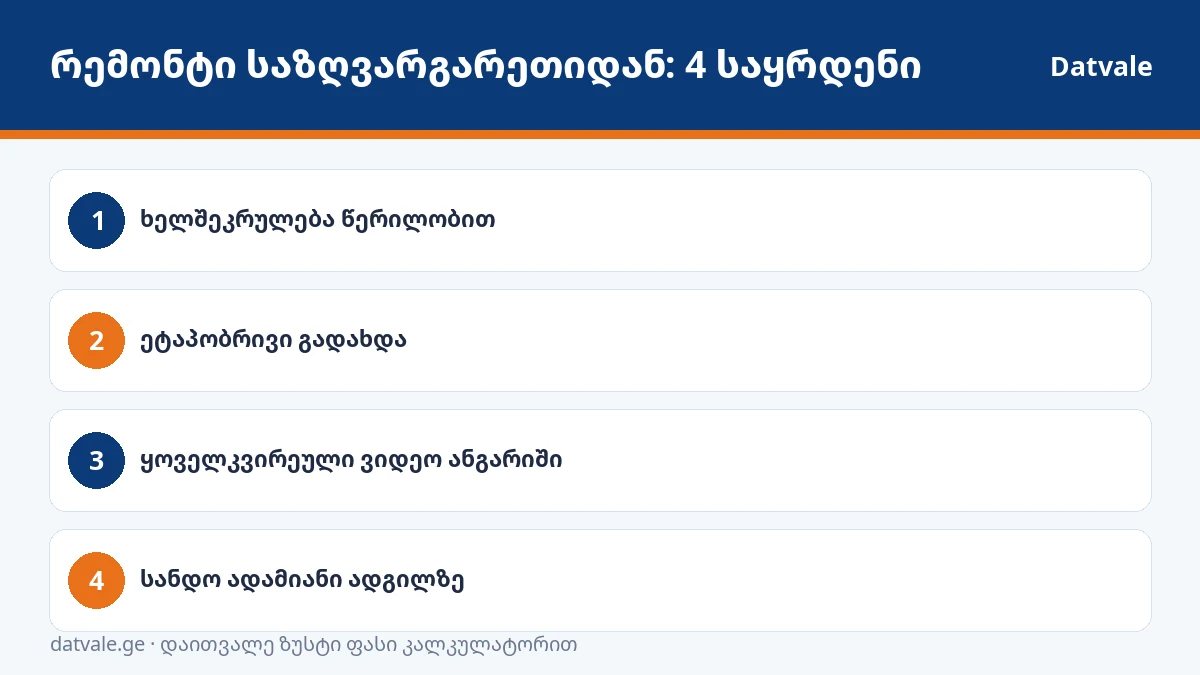
A technical brief is a document listing what work must be done, with what materials and to what quality. The more detailed it is, the fewer disagreements arise. When working from abroad, this is your strongest protective tool.
Before handing over the property, take or have photos of the apartment’s condition and send them to the contractor. Attach the plan, measurements and photos to the contract as an appendix, so that the original condition cannot be disputed later.
The technical brief should not be a one-off document. When a decision changes during the renovation, the brief must be updated and confirmed by both sides. This way there is always one current version that everyone relies on.
The most important figure in renovating from abroad is your eyes and ears on the ground. This can be a relative, a friend or a separately hired specialist. They should be able to visit the site, take photos and speak directly with the contractor.
| Option | Advantage | Risk |
|---|---|---|
| Relative or family member | Trust and flexibility | May lack technical experience |
| Designer or engineer | Professional control | Additional cost |
| You yourself by video call | No extra cost | Limited visibility |
They check whether the completed work matches the brief, accept materials and confirm the completion of each stage. If you want to formally grant trust to someone, use a power of attorney, which we discuss below.
A good representative asks the contractor questions and looks for flaws you cannot see. Explain that their role is not an accusation but protecting quality. This also reduces conflict.
If you choose a family member as representative, agree in advance how much time they will dedicate. Renovating from abroad is often damaged because someone was promised oversight but did not have the time for it.
If your representative must negotiate on your behalf, accept items or sign acts, a power of attorney is required. Abroad, it is usually notarized by a notary or at a Georgian consular office.
Legal rules and requirements may change, so check the details in an official source, for example the Legislative Herald of Georgia.
Issuing a power of attorney takes time, so start early, before the renovation begins. If it is left until the last minute, the start of work will be delayed and the contractor may move to another site.
Choosing a contractor matters more when renovating from abroad than usual, because you cannot stand over them. A name and a recommendation alone are not enough.
Send them the technical brief and ask for a cost estimate broken down by items. Compare at least several offers and pay attention not only to the final sum but also to the structure.
Also pay attention to how the contractor answers your questions. If they are impatient or avoid details from the very first conversation, this is an indicator of future communication. In a remote process, good communication matters no less than the quality of the work.
If you are interested in labor prices, see our article Did the craftsman’s price go up? 7 tricks to keep your renovation budget in check.
A verbal agreement does not work when renovating from abroad. A contract is not a sign of distrust; it is a rule that protects both sides.
The plan often changes during renovation. Write into the contract that any additional work or price change takes effect only after your written consent, even if notified by message.
Such a clear rule is especially valuable when a decision takes days to make. The contractor must know that additional costs without your consent will not be recognized.
The main rule is simple: pay for a stage after it has been completed and confirmed, not the whole amount in advance. An advance payment may be made only for materials, and only in an agreed amount.
| Stage | What is checked | When paid |
|---|---|---|
| Demolition and preparation | Photo and video report | On completion |
| Utilities (electrical, plumbing) | Inspection by the representative | After inspection |
| Walls and floors | Check of evenness and quality | When the act is signed |
| Finishing work | Final handover | After final check |
When paying, use bank transfers and record the purpose on each transaction. This way every amount is documented.
Avoid handing over cash if possible. If it is unavoidable, request a receipt stating the amount, date and purpose. A payment trail is often the most important argument in a dispute.
Materials are a large part of the renovation budget, and this is exactly where most disagreements arise. There are two options: you buy the materials, or the contractor does. Each has its drawbacks.
You can compare prices remotely too. On datvale.ge you can search prices and see several stores at once, while our partners page shows discounts. This is especially helpful when you cannot visit the site.
Request receipts or invoices and photos of each material’s packaging. Compare them with the cost estimate. Also record the brand and quality class in the contract.
On the day materials are delivered, the representative should check the quantity and condition. Damaged material should be recorded on receipt so that no dispute arises later.
For general tips on saving on materials, see Affordable renovation materials: how to buy good-quality materials cheaply.
A control system is what makes renovating from abroad manageable. If you are not on site, information must reach you regularly and in the same format.
Choose one time a week that suits both sides and hold a short video call. Its purpose is not to control everything, but to ensure visibility, make decisions and check the schedule.
Plan for the time difference. If there are several hours between the countries, schedule the call so that both sides can take part comfortably.
After the call, send a short summary: what was agreed, who does what and by when. This habit makes renovating from abroad manageable and reduces misunderstandings. The summary takes one minute, but its benefit lasts for weeks.
Handover is the moment when the work is formally completed and the final payment is made. Do not rush here, even if you already have a ticket booked.
If something is not right at handover, record it in the act and set a deadline. Keep the final part of the payment until the defect is corrected.
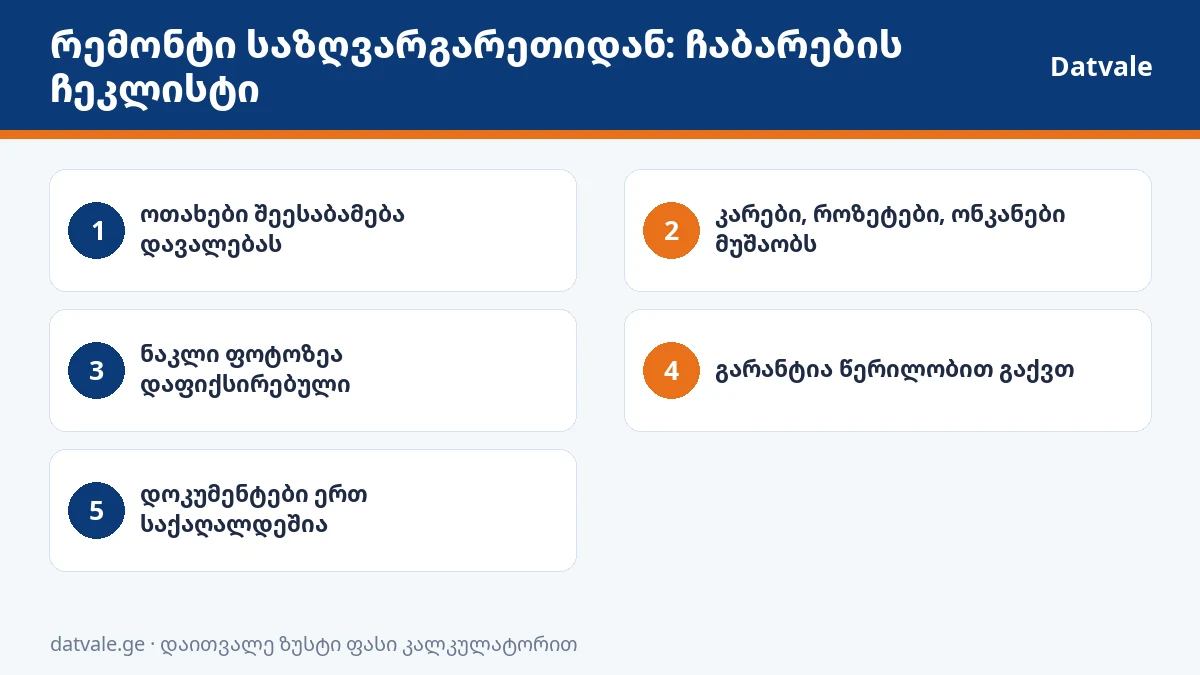
Before handover, check the documents once more: contract, acts, receipts and warranties. Keep them in one folder, both digital and on paper. They will be useful later when arranging furniture or if a fault is discovered.
Money is most often lost not through one big mistake, but through several small unchecked decisions. The table below shows typical pain points and how to protect yourself.
Another loss happens when the owner cannot attend decisions and the contractor chooses on their own. The solution is to record important choices in the document in advance and allow changes only with your consent.
| Risk | Why it happens | How to avoid it |
|---|---|---|
| Budget growth | Extra work added without notice | Changes only in writing |
| Material substitution | Cheaper equivalent | Record brand and class |
| Stretched deadlines | Schedule not controlled | Weekly report |
| Hidden defects | Superficial handover | Stage-by-stage inspection |
For a broader picture, see the budget example in Renovation budget 20,000 GEL: what you get for a 60 m² apartment in 2026.
People managing a renovation from abroad often repeat the same mistakes. Knowing them in advance can save you a lot of money.
If you agreed something important verbally, immediately send a message summarizing it. That way the agreement leaves a trail.
Transferring the full amount before work starts is the riskiest decision. Tie payments to stages.
If no one is on site, the contractor is effectively unsupervised. Appoint a representative or designer.
Some people think a video report is enough, but video does not show everything. Renovating from abroad is of higher quality when video is accompanied by a physical check on site, especially at critical stages such as wiring and waterproofing.
For a fuller list, see The 10 most expensive renovation mistakes.
The renovation timeline depends on the scope of work and the order of stages. To determine a realistic schedule, use the article Renovation timelines: 8 stages by week.
Agree that the contractor will reply to messages during the day and will notify you of urgent matters through a separate channel. This reduces waiting and misunderstandings.
Many delays happen because the owner does not choose tiles, a door or plumbing in time. Plan all selections in advance and make a list with deadlines.
When choosing online, ask the representative to photograph the sample in natural light, since colors on screens often differ from reality. In extreme cases, bring a sample into the apartment temporarily and only then order the full quantity.
When ordering furniture and appliances, remember that delivery times are often longer than the renovation schedule. Get measurements from the contractor in advance and check them, so the order goes through on time.
If the apartment is large or the renovation is complete, it is worth bringing in a professional. A designer or engineer protects you on site from information asymmetry and knows what to check.
Estimate what a single mistake would cost you: rework, missed deadlines and a second trip. Often this is greater than the specialist’s fee.
Paid oversight is especially justified when utilities are being changed, meaning electrical wiring and plumbing. These parts are hidden inside walls, and correcting a mistake later is expensive.
When agreeing with a designer or engineer, write down what their service includes: the number of site visits, the report format and their responsibilities. Renovating from abroad becomes more predictable when both sides clearly understand their roles.
The budget depends on the condition of the apartment. Below is the general logic; calculate exact figures in the calculator.
| Apartment condition | Type of work | Risk level |
|---|---|---|
| Shell (raw concrete) | Full cycle | High |
| White shell | Finishing work | Medium |
| Older apartment | Demolition and utilities | High |
| Cosmetic refresh | Painting and flooring | Low |
For details on the shell condition, see our article Accepting a shell apartment: 12 things to check before signing with the developer.
Tools can help you keep information in one place. You do not need an expensive system for this.
Create a shared folder for photos, the contract and receipts. All documents will be in one place and easy to find.
One group with you, the contractor and the representative reduces misunderstandings. All changes stay in writing in one place.
Return to the renovation calculator during the process and compare actual spending with the initial estimate. This helps you spot deviations in time.
Renovating your own apartment is an emotional process, especially when you are not nearby. It is natural to worry.
Do not try to personally control every detail. This exhausts you and can damage your relationship with the contractor. Choose three or four critical checkpoints where verification is essential and entrust the rest to reporting.
Simplify the process: a staged plan, one weekly call and clear rules reduce uncertainty. When you know what to expect, you worry less.
If you plan to return to Georgia at the end of the renovation, plan the final check in advance. Your arrival date should match the handover, not the other way around.
Many emigrants align their vacation with the completion of the renovation and book the ticket early. If the work is delayed, this creates unnecessary pressure. So plan the flight with a few days’ margin.
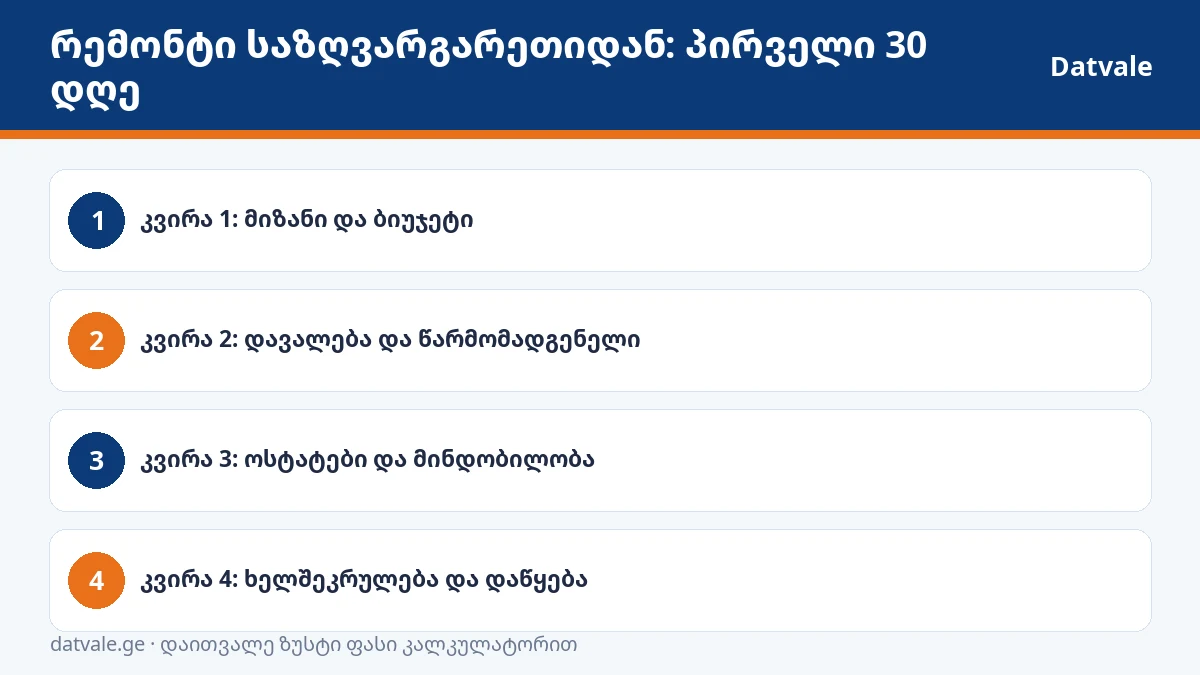
If you are starting now and do not know where to begin, the sequence below will help. The goal is for your renovation from abroad to be organized from the very first weeks.
After these four weeks, all the pillars are in your hands. The rest of the process requires only the discipline of regular reporting and staged payments.
Remember that renovating your apartment is an investment, so it is worth spending time on extra caution. Calm and clear documents often save more than the cheapest contractor.
In short, renovating from abroad is absolutely possible when you have a clear budget, a trusted contractor and regular photo reports. Renovating from abroad works best when every stage is planned in advance and each payment is tied to finished work. Many owners who start renovating from abroad say the first week of planning saves them weeks of stress later.
Before you begin renovating from abroad, calculate the expected cost with the Datvale renovation calculator and compare it with the contractor quote. This simple check makes renovating from abroad more predictable and protects your budget.
Yes, if you have a written contract, staged payments, regular video reports and one trusted person on site. These four elements significantly reduce the risk.
A power of attorney is usually notarized by a notary or at a Georgian consulate. Check the specific requirements on an official source or with a specialist.
Use the renovation calculator: enter the area and quality level and get an estimate. Then compare it with the contractor’s offer.
Not fully. Staged payment is safer: money is paid after each stage is confirmed, while materials may have an agreed advance portion.
Request regular video and photos, appoint a representative and confirm each stage in writing.
Write the consequences of delay into the contract in advance. Use the weekly report to monitor schedule compliance.
Enter the apartment’s area and choose the quality level to get a detailed estimate with materials and labor before you speak to a contractor.